Chapter 05
The Keynote
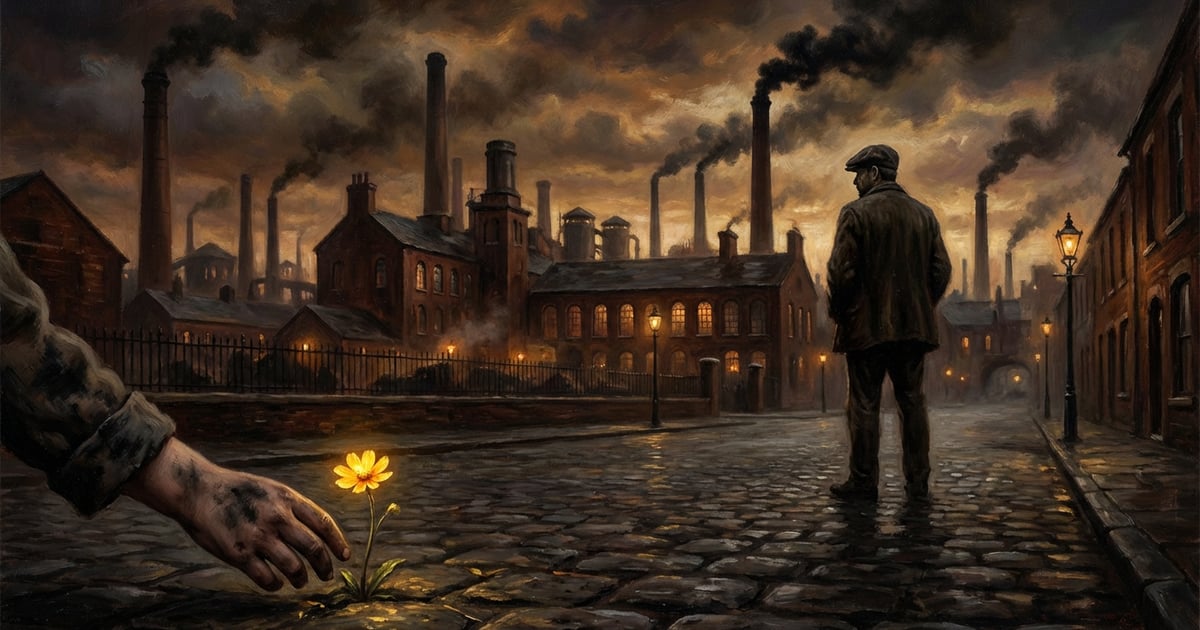
COKETOWN, to which Messrs. Bounderby and Gradgrind now walked, was a triumph of fact; it had no greater taint of fancy in it than Mrs. Gradgrind herself. Let us strike the key-note, Coketown, before pursuing our tune. It was a town of red brick, or of brick that would have been red if the smoke and ashes had allowed it; but as matters stood, it was a town of unnatural red and black like the painted face of a savage. It was a town of machinery and tall chimneys, out of which interminable serpents of smoke trailed themselves for ever…
Public-domain chapter text, formatted for reading.
Master this chapter. Complete your experience
Purchase the complete book to access all chapters and support classic literature
Available in paperback, hardcover, and e-book formats
Now let's explore the literary elements.
Key Quotes & Analysis
"Fact, fact, fact, everywhere in the material aspect of the town; fact, fact, fact, everywhere in the immaterial."
Context: Describing Coketown
The keynote of the novel: a world that has edited out everything but measurement.
In Today's Words:
Walk through the logistics park where every facade repeats, every clock syncs, every wall posts output targets, and even the break room sells efficiency. If something cannot be weighed, invoiced, or scanned, the culture behaves as if it does not exist. Fact is both brick and religion, smoke and spreadsheet.
"A town so sacred to fact, and so triumphant in its assertion, of course got on well? Why no, not quite well."
Context: After Coketown portrait
Dickens punctures the utilitarian boast: the experiment is already failing.
In Today's Words:
The city rebrands itself as data driven and posts rising productivity, then wonders why overdose maps, night shift turnover, and hidden drinking spike. Triumph on the dashboard does not guarantee thriving lives. Dickens punctures the boast early: sacred fact does not automatically heal the people living under smoke, sameness, and schedules that never ask what a body needs.
"Is it possible, I wonder, that there was any analogy between the case of the Coketown population and the case of the little Gradgrinds?"
Context: After reformers' complaints about workers
Links factory workers' craving for relief to the children's circus hunger.
In Today's Words:
After banning color and play from the plant floor, managers act shocked when workers chase relief in coin slots, pills, or secret stories. The same hunger sent the model children to the circus fence. Starve wonder in the name of reason and it returns as shameful craving, not because people are uniquely wicked but because monotony needs somewhere to breathe.
"Serve ’em right,’ said Mr. Bounderby, ‘for being idle.’"
Context: Sissy explains nine oils for circus bruises
Bounderby hears injury and answers with moral punishment.
In Today's Words:
When a teen explains she rubs nine different oils on her father's bruises after falls in the gig circus act, the executive snorts that they served him right for being idle. Injury becomes moral proof. Care gets read as failure to optimize, and pain is evidence the worker chose wrong, not that the work is brutal.
Thematic Threads
Industrial dehumanization
In This Chapter
Coketown's smoke, sameness, and fact-worship
Development
Setting established as novel's keynote
In Your Life:
You may recognize workplaces or cities where efficiency erased everything personal.
Dehumanizing systems
In This Chapter
Reformers and owners blame workers instead of examining monotony
Development
Extends from Gradgrind school to whole town
In Your Life:
You may see institutions diagnose ingratitude when they refuse to meet real need.
Class and power
In This Chapter
Bounderby mocks circus care; Bitzer polices Sissy
Development
Walk to expel outsider continues
In Your Life:
You may notice how the privileged call other people's survival strategies laziness.
You now have the context. Time to form your own thoughts.
Discussion Questions
This is not a test. Five prompts guide you through the chapter, from how it opens to how it closes, so you notice context and rhythm rather than facts to memorize. Sit with each question in your own words. When you see "One way to read it," treat it as a starting point, not the only answer.
- 1
What does Dickens mean by calling Coketown a triumph of fact, and how do the identical streets, smoky chimneys, and interchangeable buildings show that philosophy made visible?
analysis • surfaceOne way to read it
Coketown is utilitarianism built in brick and smoke. Everything looks the same because variety counts as waste. Even chapels resemble warehouses, and what cannot be priced or charted is treated as unreal. The town is Gradgrind's mind at city scale.
- 2
Why does the narrator ask whether there is an analogy between the restless Coketown workers and the little Gradgrinds, after listing drink, opium, and hidden singing rooms?
analysis • mediumOne way to read it
Both groups have had fancy deliberately set at nought. Monotonous life without relief creates craving that must go somewhere. Louisa at the circus fence and workers in low haunts are not separate moral failures. They are the same hunger returning in different forms.
- 3
Where have you seen reformers or leaders bring charts and tabular statements to prove people are ungrateful, lazy, or restless instead of asking what the system never gave them?
application • mediumOne way to read it
Think of turnover reports that blame workers for quitting without examining schedules, wellness programs that score attendance while removing real rest, or schools that publish discipline data but cut art and recess. The spreadsheet becomes the verdict; the missing outlet stays invisible.
- 4
Bitzer chases Sissy through the streets to drill her on defining a horse, while Sissy carries nine oils to treat her father's circus bruises. What does each of them show about how Coketown reads care and knowledge?
application • deepOne way to read it
Bitzer treats recitation as virtue and policing as duty. Sissy carries practical mercy for a body that gets hurt doing honest work. Coketown rewards the boy who enforces categories and mocks the girl who tends a wound, which tells you what the town truly values.
- 5
Bounderby hears nine oils and answers that performers deserve their bruises for being idle, while Dickens notes Gradgrind might have been a kind man if an old arithmetic error had gone differently. What warning does that pair of moments carry about how fact-only systems fail?
reflection • deepOne way to read it
Bounderby cannot see injury without moral punishment. Gradgrind shows the system is not only villains but a method that can flatten even decent people. A town sacred to fact misreads liniment as gin and care as idleness, which is how optimized places break while still claiming triumph on the ledger.
Critical Thinking Exercise
Find the Missing Outlet
Pick a group labeled ungrateful, lazy, or restless inside a school, company, or city. List what legitimate outlets for relief, creativity, or rest the system offers. Then list where people actually go instead.
Consider:
- •Whether monotony or overwork came before the 'bad behavior'
- •Who benefits from calling the problem moral rather than structural
- •What humane outlet would cost the system to provide
Journaling Prompt
Write about something you were forbidden to want openly and where that wanting went instead.
Coming Up Next...
Chapter 6: Sleary's Horsemanship
Upstairs at the Pegasus's Arms, Gradgrind and Bounderby meet the circus world on its own terms: faded posters, kind performers, and the father Sissy still believes in Gradgrind and Bounderby follow Sissy up the steep stairs of the Pegasus's Arms into the circus lodgings. Signor Jupe's peacock-feathered nightcap hangs on a nail, but the man, the dog, and the trunk are gone..