Chapter 04
Mr. Bounderby
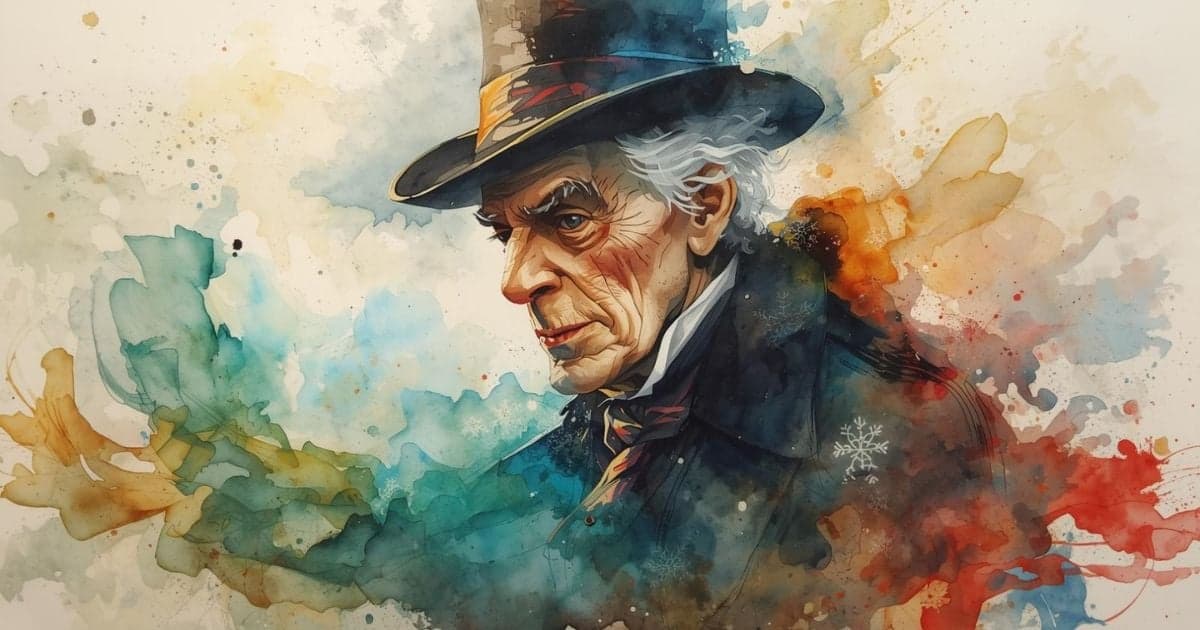
NOT being Mrs. Grundy, who was Mr. Bounderby? Why, Mr. Bounderby was as near being Mr. Gradgrind’s bosom friend, as a man perfectly devoid of sentiment can approach that spiritual relationship towards another man perfectly devoid of sentiment. So near was Mr. Bounderby—or, if the reader should prefer it, so far off. He was a rich man: banker, merchant, manufacturer, and what not. A big, loud man, with a stare, and a metallic laugh. A man made out of a coarse material, which seemed to have been stretched to make so much of him. A man with a great puffed…
Public-domain chapter text, formatted for reading.
Master this chapter. Complete your experience
Purchase the complete book to access all chapters and support classic literature
Available in paperback, hardcover, and e-book formats
Now let's explore the literary elements.
Key Quotes & Analysis
"metallic laugh. A man made out of a coarse material, which seemed to have been stretched to make so much of him."
Context: Introducing Bounderby
His laugh sounds like machinery.
In Today's Words:
Even his celebration sounds machined: a metallic bark where warmth should be. People laugh on cue because he is loud and successful, not because joy is shared. The laughter warns you that everything about him, including merriment, has been stretched from coarse material into performance, and that his charisma runs on volume rather than connection.
"A man who was the Bully of humility."
Context: Introducing Bounderby
The chapter's verdict in six words: suffering recycled as dominance.
In Today's Words:
On the podcast he sells the grit story: bootstraps, basement nights, no handouts. Then he uses that history to shame anyone who asks for flexibility now. Humility becomes a weapon, not empathy; hardship is recycled so he can win arguments in the present without sharing power. Workers hear his wounds used as proof they should endure more, which is the opposite of solidarity.
"I’ll tell you in what. In idle imagination."
Context: Diagnosing the circus scandal
Wonder becomes pathology; the cure is expulsion.
In Today's Words:
When teens get caught skipping a lecture to see live music behind the loading dock, the trustee blames idle imagination as if wonder were an infection. Curiosity gets medicalized; the prescription is removal and tighter rules. No one asks what the dry curriculum lacked that made color feel necessary, or why students risk punishment just to remember they are alive.
"You may cut the piece out with your penknife if you like, Tom. I wouldn’t cry!"
Context: After Bounderby's kiss
Closing defiance: pain without tears, body treated as property.
In Today's Words:
After a forced hug from a family friend who holds money over the house, she grabs a penknife and scratches the cheek he marked, refusing tears because crying would be read as weakness. The gesture is small and fierce: you can brand me, you cannot make me perform gratitude. Pain stays private so power keeps its story.
Thematic Threads
Class and power
In This Chapter
Bounderby's self-made myth and command over Gradgrind's household
Development
Introduced as dominant force
In Your Life:
You may recognize leaders whose hardship stories become reasons to deny others relief.
Emotional suppression
In This Chapter
Louisa accepts kiss without consent and refuses to cry
Development
Deepens from Chapter 3 tiredness
In Your Life:
You may notice when showing feeling would cost more than enduring quietly.
Dehumanizing systems
In This Chapter
Sissy blamed as contamination; children treated as reason experiments
Development
Outsider marked for removal
In Your Life:
You may see institutions expel the person instead of fixing the culture.
You now have the context. Time to form your own thoughts.
Discussion Questions
This is not a test. Five prompts guide you through the chapter, from how it opens to how it closes, so you notice context and rhythm rather than facts to memorize. Sit with each question in your own words. When you see "One way to read it," treat it as a starting point, not the only answer.
- 1
What does Dickens mean by calling Bounderby the Bully of humility, and how does his story of the ditch, the egg-box, and the wicked grandmother function in the drawing room?
analysis • surfaceOne way to read it
Bounderby uses past suffering as dominance, not empathy. Every hard-luck detail becomes proof that he earned his place alone and owes no one softness. The story is a weapon dressed as modesty.
- 2
When Louisa and Tom are caught peeping at the circus, why do Gradgrind and Bounderby decide the cause must be idle imagination and contamination from Cecilia Jupe rather than a flaw in their own upbringing?
analysis • mediumOne way to read it
If reason built the child, then reason's failure must come from outside. Blaming Sissy protects the system from asking what facts-only life lacks. Expelling the stroller's child is easier than hearing Louisa's tiredness.
- 3
Where have you seen someone use a self-made or hardship story to shut down complaints from people who are still struggling?
application • mediumOne way to read it
Think of the manager who says I started in the mailroom so overtime should not bother you, the politician who cites a rough childhood to cut aid, or the parent who compares suffering to dismiss a child's honest distress. The story ends conversation instead of opening it.
- 4
Gradgrind says something has crept into his children's minds that reason has no part in. Why is that so incomprehensible to him, and what does Bounderby's order to turn Sissy out at once reveal about how the household handles mystery?
application • deepOne way to read it
Gradgrind raised them as reason experiments, so curiosity feels like corruption rather than humanity. Bounderby's do-it-at-once rule treats wonder like an infection to be cut out. Neither man asks what the children were hungry for, only who can be removed.
- 5
Louisa gives Bounderby her cheek coldly, then rubs the spot with her handkerchief until it burns red and tells Tom she would not cry if he cut the piece out. What does that sequence reveal about her place in this family and the reward the system offers a compliant girl?
reflection • deepOne way to read it
She is treated as future property, not a person with consent. The kiss is payment for obedience, and she erases it physically because tears would be read as fancy. Her defiance is quiet, but the burning cheek shows the body keeping score when reason forbids feeling.
Critical Thinking Exercise
Audit a Hard-Luck Story
Think of someone who often tells how they made it alone. List what the story asks you to accept and what it makes hard to ask for. Decide whether the story builds empathy or blocks it.
Consider:
- •Who gets blamed when the story becomes policy
- •What happens to people who cannot perform gratitude for the lesson
- •Whether removing an outsider would actually solve the problem
Journaling Prompt
Write about a time you were expected to accept touch, praise, or attention you did not want because refusing would cost you socially.
Coming Up Next...
Chapter 5: The Keynote
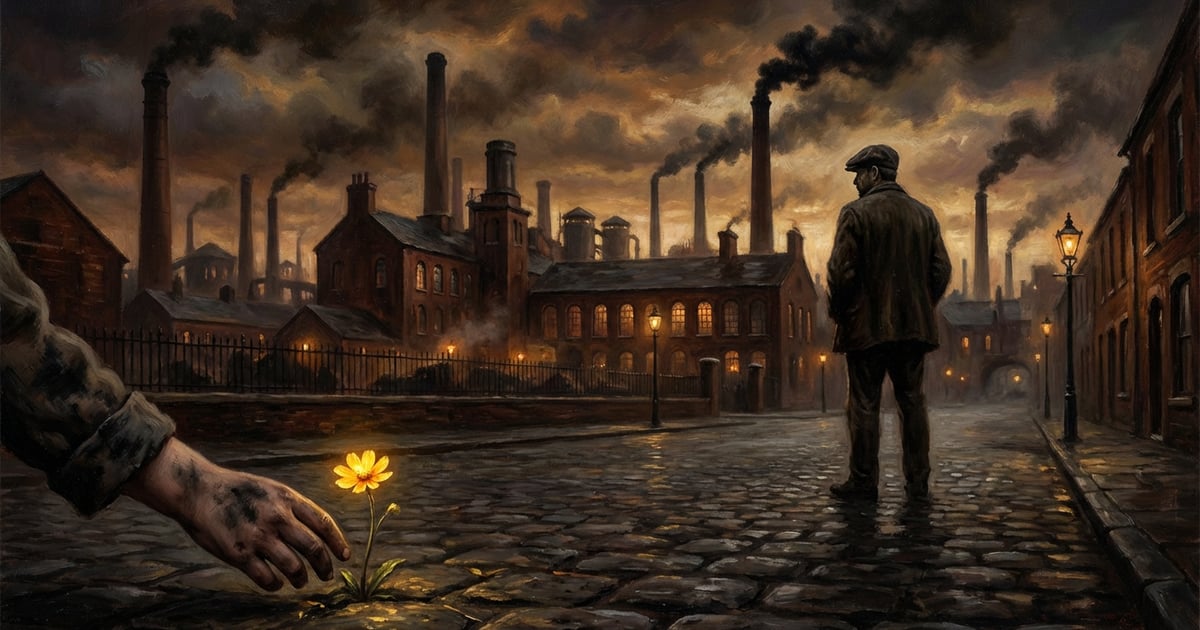
Gradgrind and Bounderby walk into Coketown itself: red brick, black smoke, identical streets, and a town so faithful to fact that it has almost no room left for human color Gradgrind and Bounderby walk into Coketown, and Dickens paints the industrial town as a triumph of fact: red and black brick, serpents of smoke, identical streets, identical lives, and fact stamped on everything from.