Chapter 34
The Starlight
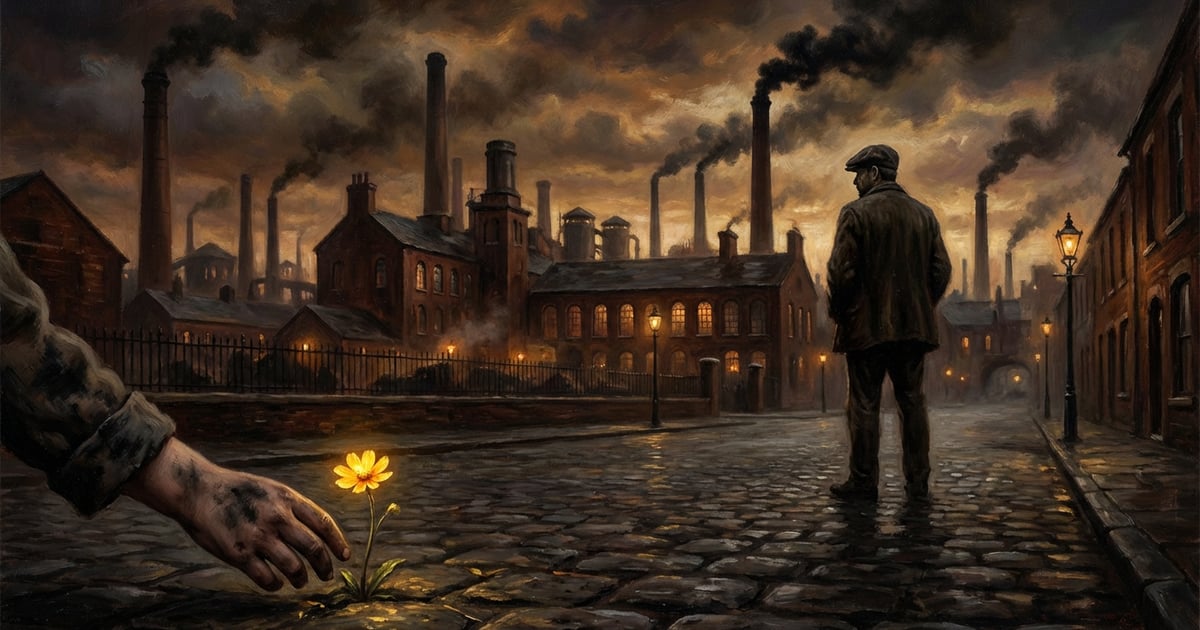
THE Sunday was a bright Sunday in autumn, clear and cool, when early in the morning Sissy and Rachael met, to walk in the country. As Coketown cast ashes not only on its own head but on the neighbourhood’s too—after the manner of those pious persons who do penance for their own sins by putting other people into sackcloth—it was customary for those who now and then thirsted for a draught of pure air, which is not absolutely the most wicked among the vanities of life, to get a few miles away by the railroad, and then begin their walk,…
Public-domain chapter text, formatted for reading.
Master this chapter. Complete your experience
Purchase the complete book to access all chapters and support classic literature
Available in paperback, hardcover, and e-book formats
Now let's explore the literary elements.
Key Quotes & Analysis
"Rachael took it up, shaking from head to foot. She broke into a passion of tears and lamentations: Stephen Blackpool was written in his own hand on the inside. ‘O the poor lad, the poor lad! He has been made away with. He is lying murdered here!"
Context: Rachael finds Stephen's hat in the grass
Discovery turns pastoral peace into horror before the pit is even seen.
In Today's Words:
Rachael picks up the hat, reads Stephen Blackpool written inside, and breaks down believing he has been murdered. The hat has no blood, but the fresh broken fence already told Sissy something was wrong. Innocence often leaves small objects before it leaves a body. A worker's name on cloth can turn a Sunday walk into the chapter's central emergency.
"O, my good Lord! He’s down there! Down there!’ At first this, and her terrific screams, were all that could be got from Rachael, by any tears, by any prayers, by any representations, by any means. It was impossible to hush her; and it was deadly necessary to hold her, or she would have flung herself down the shaft."
Context: The women find the hidden shaft brink
Love nearly becomes self-destruction; Sissy must redirect grief into rescue.
In Today's Words:
Rachael screams that Stephen is down there and would have flung herself into the pit if Sissy had not held her. Grief that knows where someone is can be as dangerous as grief that does not. Sissy repeats think of Stephen until Rachael can listen for help instead of joining him. The scene shows how industrial neglect hides death under ordinary grass.
"I ha’ fell into th’ pit, my dear, as have cost wi’in the knowledge o’ old fok now livin, hundreds and hundreds o’ men’s lives—fathers, sons, brothers, dear to thousands an’ thousands, an’ keeping ’em fro’ want and hunger. I ha’ fell into a pit that ha’ been wi’ th’ Firedamp crueller than battle. I ha’ read on ’t in the public petition, as onny one may read, fro’ the men that works in pits, in which they ha’ pray’n and pray’n the lawmakers for Christ’s sake not to let their work be murder to ’em, but to spare ’em for th’ wives and children that they loves as well as gentlefok loves theirs. When it were in work, it killed wi’out need; when ’tis let alone, it kills wi’out need. See how we die an’ no need, one way an’ another—in a muddle—every day!"
Context: Stephen speaks from the hurdle under the stars
The novel's industrial indictment spoken without rage, only truth.
In Today's Words:
Stephen tells Rachael he fell into a pit that has cost hundreds of lives and kills with or without work, as miners prayed lawmakers to stop murdering them for profit. He links Rachael's sick sister and his own case to one word: muddle. He says it faintly, without anger at anyone. When systems fail from greed and habit, the clearest witness may be the person dying inside them.
"Sir, yo will clear me an’ mak my name good wi’ aw men. This I leave to yo.’ Mr. Gradgrind was troubled and asked how? ‘Sir,’ was the reply: ‘yor son will tell yo how. Ask him. I mak no charges: I leave none ahint me: not a single word. I ha’ seen an’ spok’n wi’ yor son, one night. I ask no more o’ yo than that yo clear me—an’ I trust to yo to do ’t.’"
Context: Stephen asks Gradgrind to clear his name
He refuses to die accusing; he transfers the moral burden to Tom through the father.
In Today's Words:
Stephen asks Gradgrind to clear his name and make it good with all men, then says ask your son how and makes no charges himself. He trusts Gradgrind to do it. A dying worker wants reputation restored and points to the thief without naming him in public. The request sets Whelp-Hunting in motion while Stephen still breathes.
Thematic Threads
Human Worth
In This Chapter
Stephen's dying speech on pits and needless death
Development
Working-class dignity stated at the climax
In Your Life:
When the victim explains the system better than the owners.
Class
In This Chapter
Louisa and Gradgrind at the shaft; Stephen's prayer for understanding
Development
Classes meet under stars, not factory clocks
In Your Life:
When crisis finally puts different ranks in one circle.
Compassion
In This Chapter
Rachael and Sissy's rescue; Rachael holds Stephen's hand to the end
Development
Love persists through hours of waiting
In Your Life:
When someone runs for help and stays for the last mile.
Accountability
In This Chapter
Stephen asks Gradgrind to clear his name; points to Tom
Development
Truth passes to the father without public accusation
In Your Life:
When a witness trusts one honest person to finish the work.
Consequences
In This Chapter
Old Hell Shaft open; Stephen dies on the litter
Development
Industrial neglect becomes public funeral
In Your Life:
When ignored warnings finally become visible casualties.
You now have the context. Time to form your own thoughts.
Discussion Questions
This is not a test. Five prompts guide you through the chapter, from how it opens to how it closes, so you notice context and rhythm rather than facts to memorize. Sit with each question in your own words. When you see "One way to read it," treat it as a starting point, not the only answer.
- 1
On a quiet Sunday walk Sissy notices fresh broken fence and footsteps, Rachael finds Stephen's hat with his name inside, and at their feet they discover the hidden brink of the Old Hell Shaft. How do they find him?
analysis • surfaceOne way to read it
Small signs in still country lead to horror: new wood where fence gave way, a hat without blood but with his hand on the lining, then grass hiding a lethal drop. Sissy holds Rachael back from the pit and runs for help. Neglected industry kills under ordinary green; discovery is accident plus faithful attention, not the town's placards.
- 2
Stephen fell while crossing dangerous country at night on his way to Mr. Bounderby's country house. Why was he walking there?
analysis • mediumOne way to read it
Innocence drove him the nearest way to deliver himself up. He could not rest while the robbery charge stood and wrote that he would come back to clear himself. Rachael's letter reached him; anger at Louisa briefly misled him, but he chose to face authority rather than hide. The path to exoneration led through an unmarked shaft.
- 3
Where have you seen warnings about unsafe conditions ignored until an innocent person was hurt or killed?
application • mediumOne way to read it
Think of the abandoned site without fencing, the repeated safety petition filed away, or the worker blamed while the pit or policy stayed open. Stephen names the public petition miners sent lawmakers. When it was in work it killed without need; when let alone it still kills. Muddle becomes body count.
- 4
Dying under the stars Stephen says aw a muddle, forgives those who misunderstood him, and tells Gradgrind to clear his name by asking Tom how. Why does he leave accusation to others?
application • deepOne way to read it
He speaks without bitterness because the star cleared his mind toward forbearance, not revenge. He will not die trading charges; he trusts Gradgrind to finish justice and points to the son he will not publicly name. Louisa hears his prayer is hers. A dying witness transfers moral burden to those who still have power to act.
- 5
The crowd carries Stephen gently toward the road until the walk becomes a funeral procession, and Dickens says the star showed him the God of the poor. Why end on that image rather than on the rescue?
reflection • deepOne way to read it
Rescue succeeds only long enough for truth. The novel's industrial indictment and Stephen's forgiveness meet under open sky, not factory smoke. Starlight replaces arithmetic as the light that guided him in the pit. Garnering gathers meaning from a life wrongly hunted, not from machinery that kept turning while he was lost. The procession honors humility and sorrow, not Bounderby's placards.
Critical Thinking Exercise
The Witness Who Cannot Win
Think of a case where someone near harm or death named a systemic problem without trying to win an argument. Write what they said, who was present, and what action they left for others to finish.
Consider:
- •Did they accuse by name or point elsewhere?
- •Who had power to act after they spoke?
- •What warning had been ignored before the crisis?
Journaling Prompt
Write about a time you heard someone speak with unusual clarity under pressure. What did their tone tell you that anger would have hidden?
Coming Up Next...
Chapter 35: Whelp-Hunting
Stephen is cleared in death, but the thief is still free. In Whelp-Hunting the town turns from the shaft to Tom Gradgrind while Louisa and Sissy race to save him from himself Before the ring at the Old Hell Shaft breaks up, Sissy whispers to Tom behind Bounderby's shadow and he vanishes. Gradgrind tells Bounderby his son must work at a distance, names Stephen's.