Wide Reads
Literature MattersLife IndexEducators
Sign in
Where to Begin

Effects in the Bank — Hard Times

Hard Times - Effects in the Bank

Charles Dickens

Hard Times

Effects in the Bank

Home›Books›Hard Times›Chapter 17: Effects in the Bank
Previous
17 of 36
Next

Analysis by the Wide Reads editorial team·Reviewed against the source text·Updated May 26, 2026

Summary

Effects in the Bank

Hard Times by Charles Dickens

0:000:00
Listen to Next Chapter

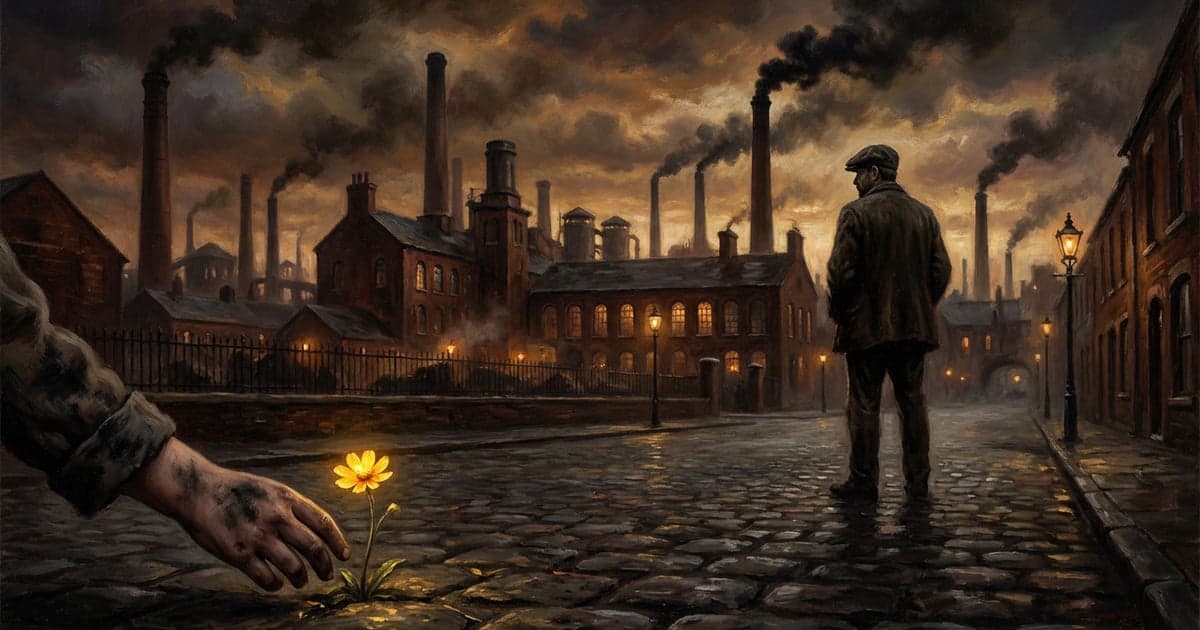
Book the Second opens on a rare sunny midsummer day in Coketown, which from a distance is only a sulky blotch of soot: you know a town must be there because nothing else could make so formless a smear on the landscape. Dickens satirizes the mill owners as fragile china, ruined whenever children were sent to school, whenever inspectors looked into their works, whenever anyone doubted they were quite justified in chopping people up with machinery, utterly undone when told they might make less smoke. Another town fiction holds that any challenge to their privilege makes them threaten to pitch property into the Atlantic; they never do, and the town keeps growing.

Heat fries the streets in oil and steam. Factory pistons beat like melancholy mad elephants, unchanged by weather. Boys row a dyed black river; the sun engenders more death than life where sordid hands intervene. Mrs. Sparsit keeps her afternoon post at the Bank, still pitying Bounderby as Victim a year into his marriage, fancying herself the Bank Fairy while passersby see a dragon guarding treasure she only half understands.

Bitzer knuckles his forehead over tea, reports workers uniting, and trades gossip about an improvident individual at the Bank without naming Tom. Sparsit forbids names under her roof while extracting coded intelligence. Bitzer praises his own savings, rejects recreation and families for workers, and boasts of putting his mother in the workhouse on principle while allowing her half a pound of tea a year.

James Harthouse arrives with a letter from Gradgrind MP, mistakes the Bank for Bounderby's house, and charms Mrs. Sparsit into giving directions. He asks whether Louisa is repellently clever; she laughs and says a chit, not twenty when married. He leaves astonished. Bitzer suspects he games. Mrs. Sparsit watches darkness climb the chimneys without lighting a candle, then sits alone at supper and mutters, O, you Fool, without naming whom she means.

In this chapter: Terms Characters Key Quotes Themes Modern Story

Why This Matters

Connect literature to life

Skill: Reading Institutional Performance

Power in a company town often looks like pity, principle, and polish before it looks like force. Mill owners cry ruin while growing, Mrs Sparsit pities Bounderby into loyalty, Bitzer reports union talk, and Harthouse asks if the soot is always this black. Notice when banks and offices run on performed virtue, coded gossip, and outsiders who treat local pain as scenery.

Coming Up in Chapter 18

James Harthouse settles into Coketown and the Gradgrind circle: a polished cynic bored by everything, drawn toward Louisa while Tom treats the bank like his private account.

Share it with friends

PreviousPrevious ChapterNextNext Chapter
Original text
4,677 wordscomplete

Chapter 17

Effects in the Bank

A SUNNY midsummer day. There was such a thing sometimes, even in Coketown. Seen from a distance in such weather, Coketown lay shrouded in a haze of its own, which appeared impervious to the sun’s rays. You only knew the town was there, because you knew there could have been no such sulky blotch upon the prospect without a town. A blur of soot and smoke, now confusedly tending this way, now that way, now aspiring to the vault of Heaven, now murkily creeping along the earth, as the wind rose and fell, or changed its quarter: a dense formless…

Public-domain chapter text, formatted for reading.

Master this chapter. Complete your experience

Purchase the complete book to access all chapters and support classic literature

Buy at Powell'sBuy on Amazon

Available in paperback, hardcover, and e-book formats

Now let's explore the literary elements.

Key Quotes & Analysis

"Surely there never was such fragile china-ware as that of which the millers of Coketown were made."

— Narrator

Context: Satire on mill owners and reform

Owners claim ruin at every humane limit while staying profitable.

In Today's Words:

Factory owners behave like fragile china: send a child to school and they shatter; appoint an inspector and they crack; suggest less smoke or fewer limbs in the machinery and they are utterly undone. They never actually fail. They just perform catastrophe whenever anyone asks them to share power. Modern executives use the same script when a minor rule threatens margins they still report as healthy.

"But no temperature made the melancholy mad elephants more mad or more sane."

— Narrator

Context: Midsummer heat and factory rhythm

Industrial motion ignores weather and feeling alike.

In Today's Words:

On the hottest day, the factory pistons beat like mad elephants, neither madder nor saner for sun or rain. Workers fry in oil and steam while shadows of shafts replace trees. The rhythm does not soften for bodies. If you have worked a line that never slows for heat, illness, or grief, you know this beat: the machine sets the pulse, not the person.

"What one person can do, another can do."

— Bitzer

Context: Blaming workers for not saving like him

Bitzer voices the capitalist fiction Dickens exposes next sentence.

In Today's Words:

A bank clerk tells the housekeeper that if he can put money by on low wages, any worker could. He skips rent luck, injury, and family size. The next paragraph calls this a Coketown fiction: the man who made sixty thousand pounds from sixpence always wonders why sixty thousand hands did not do the same. Bootstrap sermons sound principled until you notice who profits from the guilt.

"Will you allow me to ask you if it’s _always_ as black as this?"

— James Harthouse

Context: First impression of Coketown

Harthouse treats the town as aesthetic complaint, not lived harm.

In Today's Words:

A bored gentleman from London strolls into the soot and asks if the factory town is always this black. He frames pollution as scenery, not lung damage. The housekeeper will answer that it is usually worse. Outsiders often aestheticize places they are about to exploit, commenting on the view while the people who breathe it cannot leave. Charm arrives before consequence.

Thematic Threads

Industrial satire

In This Chapter

China millers, Atlantic threat, mad elephant pistons

Development

Book Two opens by naming how owners cry ruin and keep growing

In Your Life:

You may hear collapse predicted whenever accountability arrives, yet profits continue.

Surveillance and class

In This Chapter

Bitzer spies; Sparsit forbids Tom's name; union talk

Development

Bank order depends on informers and coded gossip

In Your Life:

You may see politeness used to extract loyalty and report dissent.

Outsider arrival

In This Chapter

Harthouse bored, asks about Louisa as curiosity

Development

Sets up Reaping plot; Louisa reduced to reputation and age

In Your Life:

You may meet people who charm gatekeepers before they know who they are hurting.

You now have the context. Time to form your own thoughts.

Discussion Questions

This is not a test. Five prompts guide you through the chapter, from how it opens to how it closes, so you notice context and rhythm rather than facts to memorize. Sit with each question in your own words. When you see "One way to read it," treat it as a starting point, not the only answer.

  1. 1

    Why does Dickens open Book the Second with mill owners compared to fragile china that falls to pieces whenever children go to school or smoke might be reduced, yet threaten to pitch property into the Atlantic without ever doing so?

    ▶One way to read it

    Owners perform catastrophe whenever reform touches profit, then keep growing anyway. The Atlantic threat is a fiction that terrifies officials while the town multiplies. Dickens shows power that cries ruin to avoid accountability and never follows through on its own bluster.

    analysis • surface
  2. 2

    Mrs. Sparsit still pities Bounderby as Victim a year into his marriage while acting as Bank Fairy to herself and dragon to the street. How does that performed pity relate to her real power at the Bank?

    ▶One way to read it

    Pity is leverage dressed as sacrifice. She keeps moral altitude over the man who pays her annual compliment while guarding desks, keys, and gossip after hours. Grace and surveillance share the same chair by the window.

    analysis • medium
  3. 3

    Bitzer tells Mrs. Sparsit that workers should save as he does, rejects recreation and families as nonsense, and boasts of placing his own mother in the workhouse on principle. Where have you seen personal discipline sermons used to blame people for structural hardship?

    ▶One way to read it

    Think of the intern who lectures coworkers on skipping coffee while inheriting rent support, the policy maker who cites one bootstrap story against a crowd, or the colleague who reports spending habits upward as moral proof. What one person can do ignores luck, wages, and who holds the keys.

    application • medium
  4. 4

    Mrs. Sparsit forbids Bitzer to name Tom at the Bank while still extracting coded gossip about an improvident individual with a friend at court, and Harthouse arrives asking whether Coketown is always this black and whether Louisa is repellently clever. What do those two scenes show about how information and people move in this world?

    ▶One way to read it

    The Bank runs on polite censorship and polished curiosity. Names are forbidden when they touch the patron, yet damage travels in hints. Outsiders treat soot as scenery and Louisa as a reputation to be sized up before she enters the room. Order looks genteel; underneath it is informers, class contempt, and boredom hunting a target.

    application • deep
  5. 5

    Harthouse is astonished to learn Louisa was not twenty when she married, and Mrs. Sparsit ends alone muttering, O, you Fool, without naming whom she means. Why are those two closing notes important for Book the Second?

    ▶One way to read it

    Harthouse misreads Gradgrind's hard-headed myth and sees a young woman as a puzzle, not a person. Sparsit's fool is still unnamed, but the reader feels misjudgment already gathering around Louisa's marriage. Reaping opens with the harvest of facts: a chit handed to power, and a gatekeeper who knows someone has walked in blind.

    reflection • deep

Critical Thinking Exercise

10 minutes

Map the Bank After Hours

Think of an office or institution after closing: who stays, who serves tea, who reports what. Write who performs pity, who performs principle, and who asks aesthetic questions without touching the harm.

Consider:

  • •Who is forbidden to name certain people
  • •Who benefits from coded gossip
  • •Who treats the place as scenery

Journaling Prompt

Write about a time you realized the orderly surface of a workplace hid surveillance or contempt.

Coming Up Next...

Chapter 18: Mr. James Harthouse

James Harthouse settles into Coketown and the Gradgrind circle: a polished cynic bored by everything, drawn toward Louisa while Tom treats the bank like his private account.

Continue to Chapter 18
Previous
Husband and Wife
Contents
Next
Mr. James Harthouse
Keep exploring

Continue Exploring

Study guides, teaching tools, themes, and the full library.More ways to read Hard Times: study guides, teaching tools, and the wider library.

  • Hard Times Study Guide
  • Teaching Resources
  • Essential Life Index
  • Browse by Theme
  • All Books

Life-skill deep dives in Hard Times

  • Reclaiming ImaginationExplore reclaiming imagination through Hard Times by Charles Dickens. Life lessons from classic literature applied to modern challenges.
  • Recognizing Dehumanizing SystemsExplore recognizing dehumanizing systems through Hard Times by Charles Dickens. Life lessons from classic literature applied to modern challenges.
  • Recovering from Emotional SuppressionExplore recovering from emotional suppression through Hard Times by Charles Dickens. Timeless wisdom for modern life.
  • Seeing Through Productivity ObsessionExplore seeing through productivity obsession through Hard Times by Charles Dickens. Timeless wisdom for modern life.

You Might Also Like

A Tale of Two Cities cover

A Tale of Two Cities

Charles Dickens

Also by Charles Dickens

Great Expectations cover

Great Expectations

Charles Dickens

Also by Charles Dickens

A Christmas Carol cover

A Christmas Carol

Charles Dickens

Also by Charles Dickens

Heart of Darkness cover

Heart of Darkness

Joseph Conrad

Explores society & class

Browse all 106+ books

Share This Chapter

Know someone who'd enjoy this? Spread the wisdom!

TwitterFacebookLinkedInEmail

Go further with Prestige

Unlock study guides and downloads, early access, and exclusive content — and support free access for everyone.

Subscribe to PrestigeCreate free account
Intelligence Amplifier
Intelligence Amplifier™Powering Wide Reads

Exploring human-AI collaboration through books, essays, and philosophical dialogues. Classic literature transformed into navigational maps for modern life.

2025 Books

→ The Amplified Human Spirit→ The Alarming Rise of Stupidity Amplified→ San Francisco: The AI Capital of the World
Visit intelligenceamplifier.org
hello@widereads.com

WideReads Originals

→ You Are Not Lost→ The Last Chapter First→ The Lit of Love→ Wealth and Poverty→ Wisdom for the Wounded
Arvintech
arvintechAmplify your Mind
Visit at arvintech.com

Navigate

  • Home
  • Library
  • Essential Life Index
  • How It Works
  • Subscribe
  • Account
  • About
  • Contact
  • Authors
  • Suggest a Book
  • Landings

Made For You

  • Trending
  • Students
  • Educators
  • Families
  • Readers
  • Literary Analysis
  • Finding Purpose
  • Letting Go
  • Recovering from a Breakup
  • Corruption
  • Gaslighting in the Classics

Newsletter

Weekly insights from the classics. Amplify Your Mind.

Legal

  • Privacy Policy
  • Terms of Service
  • Editorial Standards
  • Cookie Policy
  • Accessibility

Why Public Domain?

We focus on public domain classics because these timeless works belong to everyone. No paywalls, no restrictions—just wisdom that has stood the test of centuries, freely accessible to all readers.

Public domain books have shaped humanity's understanding of love, justice, ambition, and the human condition. By amplifying these works, we help preserve and share literature that truly belongs to the world.

A Pilgrimage

Powell's City of Books

Portland, Oregon

If you ever find yourself in Portland, walk to the corner of Burnside and 10th. The building takes up an entire city block. Inside is over a million books, new and used on the same shelf, organized by color-coded rooms with names like the Rose Room and the Pearl Room. You can lose an afternoon. You can lose a weekend. You will find a book you have been looking for your whole life, and three you did not know existed.

It is a pilgrimage. We cannot find a bookstore like it anywhere on earth. If you read the classics, and you ever get the chance, go. It belongs on every reader's bucket list.

Visit powells.com

We are not in any way affiliated with Powell's. We are just a very big fan.

© 2026 Wide Reads™. All Rights Reserved.

Intelligence Amplifier™ and Wide Reads™ are proprietary trademarks of Arvin Lioanag.

Copyright Protection: All original content, analyses, discussion questions, pedagogical frameworks, and methodology are protected by U.S. and international copyright law. Unauthorized reproduction, distribution, web scraping, or use for AI training is strictly prohibited. See our Copyright Notice for details.

Disclaimer: The information provided on this website is for general informational and educational purposes only and does not constitute professional, legal, financial, or technical advice. While we strive to ensure accuracy and relevance, we make no warranties regarding completeness, reliability, or suitability. Any reliance on such information is at your own risk. We are not liable for any losses or damages arising from use of this site. By using this site, you agree to these terms.