Wide Reads
Literature MattersLife IndexEducators
Sign in
Where to Begin

Gulliver's Great Escape — Gulliver's Travels

Gulliver's Travels - Gulliver's Great Escape

Jonathan Swift

Gulliver's Travels

Gulliver's Great Escape

Home›Books›Gulliver's Travels›Chapter 8: Gulliver's Great Escape
Previous
8 of 39
Next

Analysis by the Wide Reads editorial team·Reviewed against the source text·Updated December 11, 2025

Summary

Gulliver's Great Escape

Gulliver's Travels by Jonathan Swift

0:000:00
Listen to Next Chapter

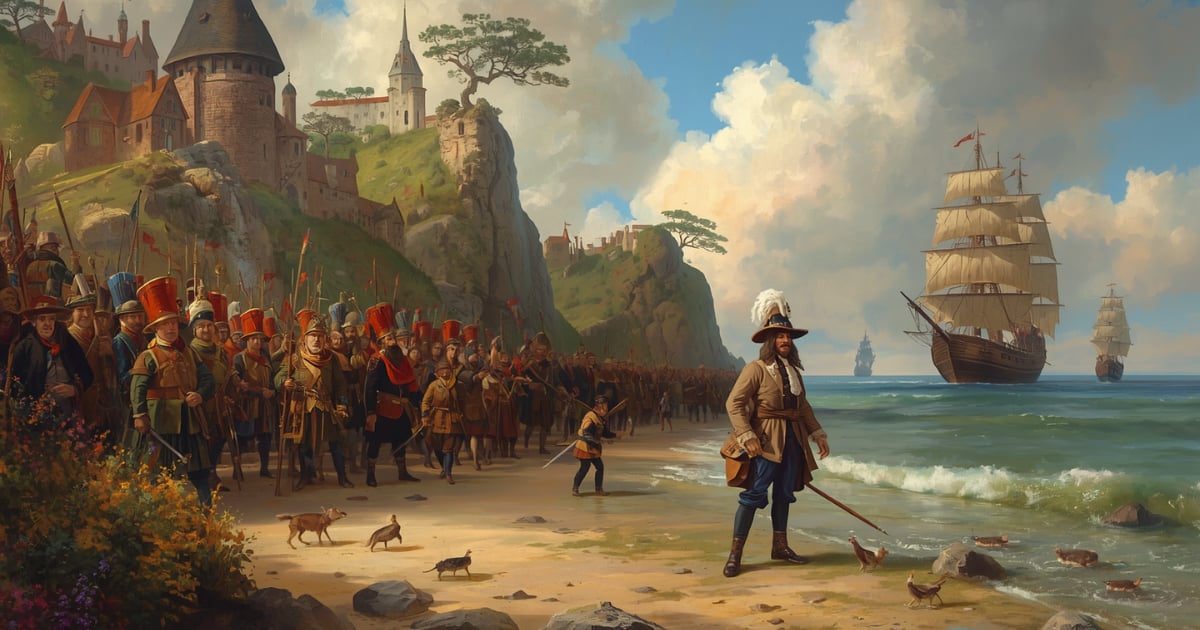
Three days after arriving in Blefuscu, Gulliver walks the north, east coast and spots something half a league out to sea, a capsized boat, probably driven from a ship in a storm. He wades out to confirm it, then returns to the city and borrows 20 of the Emperor's remaining vessels and 3,000 seamen under a vice, admiral. The fleet sails around while Gulliver swims directly to the boat, fastens a cord to its prow, and tries to tow, but out of his depth he cannot work. He swims behind and pushes it forward with one hand in stages, resting between each shove, until the water is down to his armpits. Then he rigs the ship cables and has the seamen tow while he pushes, until the boat is 40 yards from shore. At low tide he walks to it dry. Two thousand men with ropes and engines help flip it right, side, up, it is only slightly damaged. It takes another ten days to paddle it to the royal port. He asks the Emperor for permission and materials to fit it up, which is granted after some gentle reluctance. He then wonders why no message has come from Lilliput. He learns privately that the Lilliput emperor had assumed Gulliver was simply completing his licensed visit and would return on his own. After waiting out a long absence, Lilliput finally dispatched an envoy with the articles of impeachment, describing the sentence of blinding as "great lenity" and demanding Gulliver be returned to face it "bound hand and foot." The Blefuscu emperor took three days to compose his reply: impossble to send him bound; Gulliver had done the empire great service in the peace; but "both their majesties would soon be made easy," as Gulliver has found a vessel and will depart. The Emperor then tells Gulliver everything and offers private protection if he will stay in Blefuscu's service. Gulliver thanks him and declines. He has decided, he writes, "never more to put any confidence in princes or ministers, where I could possibly avoid it." He tells the Emperor he would rather venture himself on the ocean than be a cause of further dispute between the two empires. The Emperor is not displeased. Gulliver later learns that the Emperor and most of the ministers were glad of his resolution. The departure preparations take a month. Five hundred workmen sew two sails from thirteen folds of the strongest linen. Gulliver twists ropes by hand from ten, twenty, and thirty of their own strands. A large stone from the shore serves as his anchor. The tallow of 300 cows goes to greasing the boat. Ship, carpenters smooth the oars and masts after he does the rough cutting. At the farewell ceremony the Emperor gives him 50 purses of 200 sprugs each, plus his portrait at full length, which Gulliver immediately puts into one of his gloves to keep it from damage. He stores the boat with 100 oxen carcasses, 300 sheep, meat ready, dressed by 400 cooks, six cows and two bulls alive, ewes and rams, hay and corn. He asks to take a dozen natives; the Emperor refuses and searches his pockets. He sails 24 September 1701 at six in the morning. On 26 September he sights an English sail, gains on it, and is taken aboard. The ship is an English merchantman returning from Japan; the captain, John Biddel of Deptford, thinks Gulliver raving from his ordeal until Gulliver takes the tiny cattle out of his pocket. The captain is convinced. An old friend, Peter Williams, is aboard and vouches for him. Gulliver gives the captain two purses of 200 sprugs and promises him a cow and a pregnant sheep on arrival in England. He lands at the Downs on 13 April 1702. One rat had got into his things during the voyage and stripped a sheep to the bones; the rest survive. He puts the cattle to graze at Greenwich, where the grass is so fine they do better than he expected. He earns a considerable profit showing them to persons of quality and sells the lot for £600 before his second voyage. He stays two months with his wife and family, sets her up with £1,500 in a house at Redriff. His son Johnny is at the grammar school; his daughter Betty is at her needlework. He boards the Adventure, bound for Surat under Captain John Nicholas of Liverpool. Part I ends here.

In this chapter: Terms Characters Key Quotes Themes Modern Story

Why This Matters

Connect literature to life

Skill: Reading Power Dynamics

When someone powerful offers to protect you, the question is not whether they mean well but what they expect in return. Gulliver is pursued by Lilliput with an envoy demanding he return bound for blinding, courted by Blefuscu with an offer of sanctuary that would make him a prize again, and he chooses instead to repair a found boat and risk the open sea, deciding he will never again put his fate in the hands of princes if he can avoid it. That the dangerous path of independence is often safer than the comfortable cage of someone else's protection, and that getting home does not always mean you are finished running.

Coming Up in Chapter 9

Gulliver's next voyage takes an unexpected turn when he finds himself in a land where he's no longer the giant, he's become the tiny one. His perspective on size, power, and vulnerability is about to be completely reversed.

Share it with friends

PreviousPrevious ChapterNextNext Chapter
Original text
2,378 wordscomplete

Chapter 08

Gulliver's Great Escape

The author, by a lucky accident, finds means to leave Blefuscu; and, after some difficulties, returns safe to his native country. Three days after my arrival, walking out of curiosity to the north-east coast of the island, I observed, about half a league off in the sea, somewhat that looked like a boat overturned. I pulled off my shoes and stockings, and, wading two or three hundred yards, I found the object to approach nearer by force of the tide; and then plainly saw it to be a real boat, which I supposed might by some tempest have been driven…

Public-domain chapter text, formatted for reading.

Master this chapter. Complete your experience

Purchase the complete book to access all chapters and support classic literature

Buy at Powell'sBuy on Amazon

Available in paperback, hardcover, and e-book formats

Now let's explore the literary elements.

Key Quotes & Analysis

"I resolved never more to put any confidence in princes or ministers, where I could possibly avoid it."

— Narrator (Gulliver)

Context: Gulliver's private conclusion after the Blefuscu emperor describes the Lilliputian demand and offers his own protection in return

The sentence marks the end of Gulliver's political education in Part I. Every episode in Lilliput has led here: the rope, dancing promotions, the liberty articles, the conspiracy, and now the two emperors using him as a diplomatic subject. The resolution is not cynicism but calibration. He does not say he will never trust anyone, he says he will avoid dependence on princes and ministers where he possibly can. The qualification matters.

In Today's Words:

I decided I was done trusting powerful people to have my interests at heart, whenever I had a choice in the matter. The same pressure appears whenever you walk into a room that already decided the rules before you arrived, and your size or status does not matter until you learn who controls the floor.

"I told him, that since fortune, whether good or evil, had thrown a vessel in my way, I was resolved to venture myself on the ocean, rather than be an occasion of difference between two such mighty monarchs."

— Narrator (Gulliver), reporting his reply to the Blefuscu emperor's offer of protection

Context: Gulliver's diplomatic but firm refusal of the Blefuscu emperor's offer to shelter him from Lilliput

The politeness of the phrasing is precise: he does not say the offer is dangerous or self, serving, he frames his departure as a gift to both emperors, removing an inconvenient problem. He is not fleeing; he is choosing. Swift shows Gulliver has learned to decline power's offers in the language power understands.

In Today's Words:

I told him that since luck had dropped a boat in my way, I would rather take my chances at sea than keep being the thing two powerful people argue over. The same pressure appears whenever you walk into a room that already decided the rules before you arrived, and your size or status does.

"he thought I was raving, and that the dangers I underwent had disturbed my head; whereupon I took my black cattle and sheep out of my pocket, which, after great astonishment, clearly convinced him of my veracity."

— Narrator (Gulliver)

Context: Gulliver trying to explain himself to Captain Biddel after being picked up at sea

The tiny livestock are the physical proof that Gulliver's extraordinary experience was real. Swift uses the moment to note the gap between lived experience and the world's willingness to believe it, a gap that only concrete evidence can close. Gulliver's whole story in miniature: something impossible happened, and the proof fits in a coat pocket.

In Today's Words:

He figured I'd lost my mind, until I pulled the tiny cattle and sheep out of my pocket, which pretty quickly settled the question. The same pressure appears whenever you walk into a room that already decided the rules before you arrived, and your size or status does not matter until you learn who controls.

"herein I was, however, much assisted by his majesty’s ship-carpenters, who helped me in smoothing them, after I had done the rough work."

— Narrator (Gulliver)

Context: A line from this chapter that sharpens the central conflict

The sentence anchors the scene in Gulliver's own voice rather than in later commentary, which is why it still reads as evidence instead of opinion.

In Today's Words:

Gulliver names what happened in terms you can picture: who acted, what they controlled, and what choice he no longer had. The same pressure appears whenever you walk into a room that already decided the rules before you arrived, and your size or status does not matter until you learn who controls the floor.

Thematic Threads

Independence

In This Chapter

Gulliver chooses the dangerous ocean over comfortable dependence on royal protection

Development

Evolved from naive trust in authority to hard-won understanding that independence requires risk

In Your Life:

You might recognize this when deciding whether to accept help that comes with strings attached.

Power

In This Chapter

Both emperors want to control Gulliver, framing control as protection or honor

Development

Developed from seeing power as benevolent to understanding it as self-serving

In Your Life:

You see this when authority figures offer help that primarily benefits them.

Growth

In This Chapter

Gulliver has learned to read political motivations and choose his own path

Development

Progressed from naive participation in politics to strategic withdrawal

In Your Life:

You experience this when you learn to say no to opportunities that compromise your values.

Addiction

In This Chapter

Despite finding safety and profit at home, Gulliver craves more adventure after just two months

Development

Introduced here as a new complication to his character

In Your Life:

You might recognize this in your own restlessness with stability or routine.

Proof

In This Chapter

Gulliver brings tiny livestock as evidence of his incredible journey

Development

Evolved from being the spectacle to controlling the narrative of his experiences

In Your Life:

You see this when you need concrete evidence to make others believe your experiences.

You now have the context. Time to form your own thoughts.

Discussion Questions

This is not a test. Five prompts guide you through the chapter, from how it opens to how it closes, so you notice context and rhythm rather than facts to memorize. Sit with each question in your own words. When you see "One way to read it," treat it as a starting point, not the only answer.

  1. 1

    How do you maintain independence while still accepting help when you genuinely need it?

    ▶One way to read it

    Two thousand men with ropes and engines help flip it right, side, up, it is only slightly damaged. In context, the question points to a concrete beat in "Gulliver's Great Escape", not a general theme about travel or satire.

    analysis • surface
  2. 2

    Why does Gulliver refuse the Blefuscu Emperor's offer of protection and service?

    ▶One way to read it

    After waiting out a long absence, Lilliput finally dispatched an envoy with the articles of impeachment, describing the sentence of blinding as "great lenity" and demanding Gulliver be returned to face it "bound hand and foot." The Blefuscu emperor took three days to compose his reply: impossble to send him bound; Gulliver had done the empire great service in the peace; but "both their majesties would soon be made easy," as Gulliver has found a vessel and will depart. In context, the question points to a concrete beat in "Gulliver's Great Escape", not a general theme about travel or satire.

    analysis • medium
  3. 3

    What does Gulliver's decision to 'never more put confidence in princes' reveal about his growth?

    ▶One way to read it

    He has decided, he writes, "never more to put any confidence in princes or ministers, where I could possibly avoid it." He tells the Emperor he would rather venture himself on the ocean than be a cause of further dispute between the two empires. In context, the question points to a concrete beat in "Gulliver's Great Escape", not a general theme about travel or satire.

    application • medium
  4. 4

    How does the boat rescue demonstrate both Gulliver's resourcefulness and his need for others?

    ▶One way to read it

    The fleet sails around while Gulliver swims directly to the boat, fastens a cord to its prow, and tries to tow, but out of his depth he cannot work. That closing pressure is what Swift wants you to carry: not a moral label, but a clear picture of who controlled the room when how does the boat rescue demonstrate both gulliver's resourcefulness and his need for others.

    application • deep
  5. 5

    Why might the Blefuscu ministers have been 'glad of his resolution' to leave?

    ▶One way to read it

    After waiting out a long absence, Lilliput finally dispatched an envoy with the articles of impeachment, describing the sentence of blinding as "great lenity" and demanding Gulliver be returned to face it "bound hand and foot." The Blefuscu emperor took three days to compose his reply: impossble to send him bound; Gulliver had done the empire great service in the peace; but "both their majesties would soon be made easy," as Gulliver has found a vessel and will depart. That closing pressure is what Swift wants you to carry: not a moral label, but a clear picture of who controlled the room when why might the blefuscu ministers have been 'glad of his resolution' to leave.

    reflection • deep

Critical Thinking Exercise

10 minutes

Map Your Protection Network

List three people or institutions that currently provide you with some form of help or protection (job, family member, government program, etc.). For each one, honestly assess: What do they gain from helping you? What do they expect in return? What would happen if you disappointed them or no longer served their interests?

Consider:

  • •Not all help comes with strings—some people genuinely care with no agenda
  • •Even well-meaning helpers sometimes unconsciously expect gratitude or compliance
  • •The goal isn't to reject all help, but to recognize when help becomes control

Journaling Prompt

Write about a time when you had to choose between accepting someone's protection and maintaining your independence. What did you learn from that experience?

Coming Up Next...

Chapter 9: Giant Among Giants

Gulliver's next voyage takes an unexpected turn when he finds himself in a land where he's no longer the giant, he's become the tiny one. His perspective on size, power, and vulnerability is about to be completely reversed.

Continue to Chapter 9
Previous
When Loyalty Becomes a Crime
Contents
Next
Giant Among Giants
Keep exploring

Continue Exploring

Study guides, teaching tools, themes, and the full library.More ways to read Gulliver's Travels: study guides, teaching tools, and the wider library.

  • Gulliver's Travels Study Guide
  • Teaching Resources
  • Essential Life Index
  • Browse by Theme
  • All Books

Life-skill deep dives in Gulliver's Travels

  • Avoiding Righteous IsolationExplore keeping a better standard without contempt for imperfect people through Gulliver
  • Detecting Mission DriftSee when institutions keep noble language while prolonging problems in Gulliver
  • Detecting Rational CrueltyExplore measured policy language hiding harm through Gulliver
  • Reading Incentive InversionExplore who gets paid when poverty, sickness, or crisis never ends through Gulliver
  • Reading Power DynamicsMap who controls the environment when you arrive as an outsider in Gulliver
  • Reading the Outside MirrorUse outsider observation as diagnosis in Gulliver

You Might Also Like

Heart of Darkness cover

Heart of Darkness

Joseph Conrad

Explores society & class

Hard Times cover

Hard Times

Charles Dickens

Explores society & class

Candide cover

Candide

Voltaire

Explores society & class

Great Expectations cover

Great Expectations

Charles Dickens

Explores society & class

Browse all 106+ books

Share This Chapter

Know someone who'd enjoy this? Spread the wisdom!

TwitterFacebookLinkedInEmail

Go further with Prestige

Unlock study guides and downloads, early access, and exclusive content — and support free access for everyone.

Subscribe to PrestigeCreate free account
Intelligence Amplifier
Intelligence Amplifier™Powering Wide Reads

Exploring human-AI collaboration through books, essays, and philosophical dialogues. Classic literature transformed into navigational maps for modern life.

2025 Books

→ The Amplified Human Spirit→ The Alarming Rise of Stupidity Amplified→ San Francisco: The AI Capital of the World
Visit intelligenceamplifier.org
hello@widereads.com

WideReads Originals

→ You Are Not Lost→ The Last Chapter First→ The Lit of Love→ Wealth and Poverty→ Wisdom for the Wounded
Arvintech
arvintechAmplify your Mind
Visit at arvintech.com

Navigate

  • Home
  • Library
  • Essential Life Index
  • How It Works
  • Subscribe
  • Account
  • About
  • Contact
  • Authors
  • Suggest a Book
  • Landings

Made For You

  • Trending
  • Students
  • Educators
  • Families
  • Readers
  • Literary Analysis
  • Finding Purpose
  • Letting Go
  • Recovering from a Breakup
  • Corruption
  • Gaslighting in the Classics

Newsletter

Weekly insights from the classics. Amplify Your Mind.

Legal

  • Privacy Policy
  • Terms of Service
  • Editorial Standards
  • Cookie Policy
  • Accessibility

Why Public Domain?

We focus on public domain classics because these timeless works belong to everyone. No paywalls, no restrictions—just wisdom that has stood the test of centuries, freely accessible to all readers.

Public domain books have shaped humanity's understanding of love, justice, ambition, and the human condition. By amplifying these works, we help preserve and share literature that truly belongs to the world.

A Pilgrimage

Powell's City of Books

Portland, Oregon

If you ever find yourself in Portland, walk to the corner of Burnside and 10th. The building takes up an entire city block. Inside is over a million books, new and used on the same shelf, organized by color-coded rooms with names like the Rose Room and the Pearl Room. You can lose an afternoon. You can lose a weekend. You will find a book you have been looking for your whole life, and three you did not know existed.

It is a pilgrimage. We cannot find a bookstore like it anywhere on earth. If you read the classics, and you ever get the chance, go. It belongs on every reader's bucket list.

Visit powells.com

We are not in any way affiliated with Powell's. We are just a very big fan.

© 2026 Wide Reads™. All Rights Reserved.

Intelligence Amplifier™ and Wide Reads™ are proprietary trademarks of Arvin Lioanag.

Copyright Protection: All original content, analyses, discussion questions, pedagogical frameworks, and methodology are protected by U.S. and international copyright law. Unauthorized reproduction, distribution, web scraping, or use for AI training is strictly prohibited. See our Copyright Notice for details.

Disclaimer: The information provided on this website is for general informational and educational purposes only and does not constitute professional, legal, financial, or technical advice. While we strive to ensure accuracy and relevance, we make no warranties regarding completeness, reliability, or suitability. Any reliance on such information is at your own risk. We are not liable for any losses or damages arising from use of this site. By using this site, you agree to these terms.