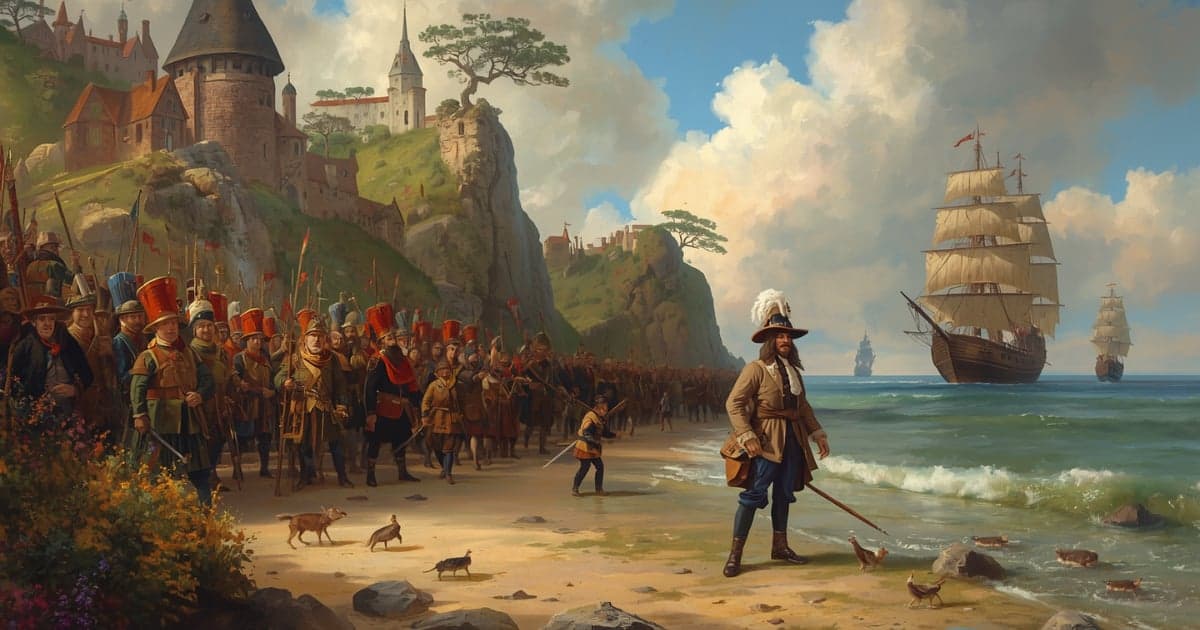
Gulliver's months of patient behaviour have paid off: children now play hide, and, seek in his hair. The Emperor rewards him with a full display of the court's entertainments, and what Gulliver sees is a satire wearing the clothes of a circus. The centrepiece is rope, dancing. Candidates for government office petition the Emperor to watch them jump on a thread twelve inches off the ground; whoever jumps highest without falling wins the post. Sitting ministers must periodically perform the same stunts to prove they still deserve their jobs. Flimnap, the treasurer, is the most accomplished dancer in the empire, once surviving a near, fatal fall only because a royal cushion happened to be lying below him. A second competition awards silk ribbons in blue, red, and green to courtiers who leap over and creep under a stick held by the Emperor; almost every senior official at court wears one of these tokens around their waist. Gulliver stages his own entertainment. He builds a handkerchief drum stretched across sticks, sets 24 mounted soldiers on it, and conducts military exercises. The Emperor is so delighted he has the performance repeated for days and eventually persuades the reluctant empress to watch. A fiery horse punches a hoof through the handkerchief; Gulliver patches it and retires the exercise. Scouts then bring news of a large black object found lying on the shore: Gulliver's lost hat, which five horses haul back on hooks tied through holes bored in the brim. Two days later the Emperor commands his grandest spectacle yet: Gulliver stands with legs spread as wide as possible and 3,000 infantry and 1,000 cavalry march through under him in full formation, drums beating, colours flying. Some of the younger officers, he notes, take advantage of the opportunity to look upward, his breeches being in a poor state of repair. Gulliver's petitions for liberty have accumulated to the point where the Emperor brings the matter to the full council. Every member votes for it except Skyresh Bolgolam, the admiral, who has been Gulliver's declared enemy from the start and without any cause that Gulliver can identify. Bolgolam is overruled but wins the right to draft the conditions himself. He arrives with nine articles. Gulliver may not leave the country without a royal license. He may not enter the capital without two hours' advance notice. He must stay on main roads. He must carry royal messengers a six, day journey once a month. He must act as an ally against the neighbouring island of Blefuscu and do his utmost to destroy their fleet. He must assist with construction work and survey the coastline. In exchange he will receive daily food equivalent to 1,724 Lilliputians. Gulliver swears in both his own manner and the Lilliputian custom: right foot held in left hand, middle finger of the right hand on the crown of his head, thumb on his right ear. The chains are immediately unlocked. The Emperor attends in person, accepts Gulliver's prostration, and tells him he hopes he will prove a useful servant. The 1,724 ration figure, Gulliver later learns, was calculated by the court mathematicians: they measured his height as twelve times a Lilliputian's, concluded that his body volume must be 12 cubed times as great, and set his food accordingly.
Coming Up in Chapter 4
Now free to explore Lilliput, Gulliver will discover the deep political divisions that threaten to tear this tiny kingdom apart. The real power struggles are just beginning Free at last, Gulliver makes his first real request: permission to visit Mildendo, the capital. The emperor agrees, issues a public proclamation, and orders citizens to stay indoors..