Wide Reads
Literature MattersLife IndexEducators
Sign in
Where to Begin

The Shame of Home — Great Expectations

Great Expectations - The Shame of Home

Charles Dickens

Great Expectations

The Shame of Home

Home›Books›Great Expectations›Chapter 14: The Shame of Home
Previous
14 of 59
Next

Analysis by the Wide Reads editorial team·Reviewed against the source text·Updated December 1, 2025

Summary

The Shame of Home

Great Expectations by Charles Dickens

0:000:00
Listen to Next Chapter

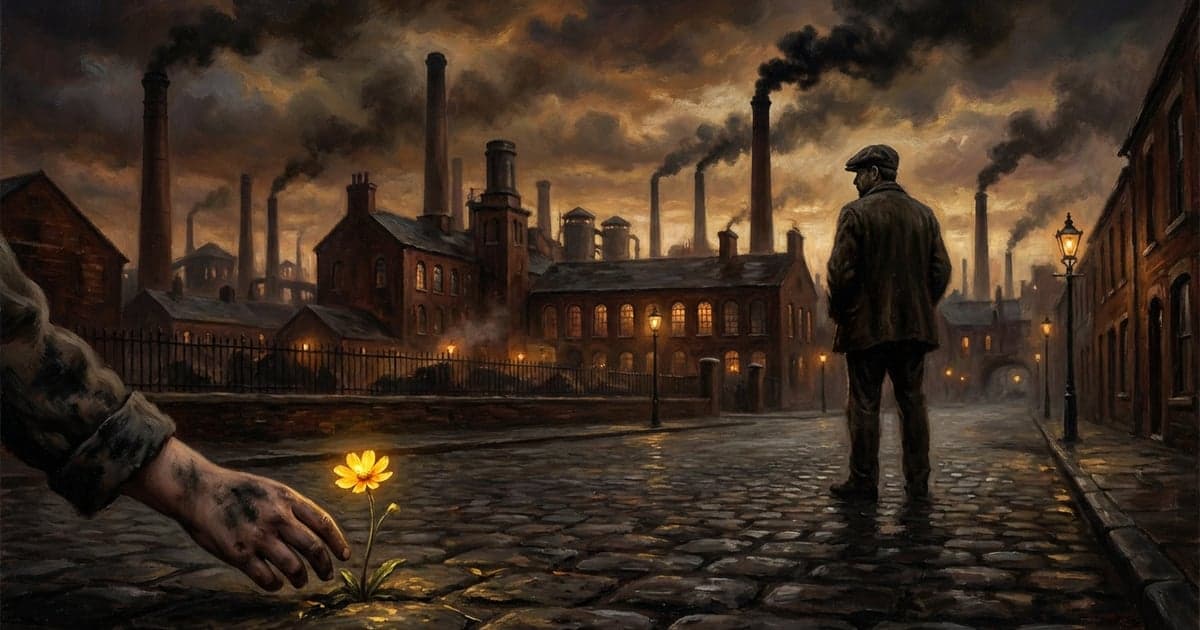
Life as an apprentice blacksmith settles into a monotonous routine that Pip finds increasingly unbearable, though he recognizes the ingratitude and injustice of his discontent. Joe treats him with affection and teaches his trade patiently, while Pip silently resents everything about his situation. The work itself, the fire, the hammer, the coarse labor, reminds him daily of what Estella would think of his hands and his status. His dissatisfaction creates a guilty self-awareness: he knows Joe deserves better than this sullen, ashamed apprentice, yet he cannot force himself to feel grateful for a future he desperately wants to escape. The contrast between what he should feel (grateful, content) and what he actually feels (trapped, ashamed) creates a constant internal conflict. Biddy remains a steady presence, someone who could have been a friend and equal if he weren't so consumed with his futile obsession with Estella. The chapter captures the painful period of young adulthood where external circumstances clash with internal dreams, and where the path forward seems simultaneously settled and unbearable. Pip's awareness of his own ungraciousness makes him more sympathetic even as it fails to change his feelings, showing how self-knowledge doesn't always lead to self-improvement.

In this chapter: Terms Characters Key Quotes Themes Modern Story

Why This Matters

Connect literature to life

Skill: Detecting Class Shame

Fear and social pressure can force good people into choices they would never make in daylight. Detecting Class Shame starts with noticing that trap before you are inside it. This week, notice when you suddenly feel ashamed of things that once brought satisfaction, ask yourself whose eyes you're seeing through and whether that perspective serves you.

Coming Up in Chapter 15

Pip's education takes a new turn as he outgrows his current teacher. Biddy emerges as a more significant figure in his development, bringing new knowledge and perhaps new complications to his already conflicted world.

Share it with friends

PreviousPrevious ChapterNextNext Chapter
Original text
828 wordscomplete

Chapter 14

The Shame of Home

It is a most miserable thing to feel ashamed of home. There may be black ingratitude in the thing, and the punishment may be retributive and well deserved; but that it is a miserable thing, I can testify. Home had never been a very pleasant place to me, because of my sister’s temper. But, Joe had sanctified it, and I had believed in it. I had believed in the best parlour as a most elegant saloon; I had believed in the front door, as a mysterious portal of the Temple of State whose solemn opening was attended with a sacrifice…

Public-domain chapter text, formatted for reading.

Master this chapter. Complete your experience

Purchase the complete book to access all chapters and support classic literature

Buy at Powell'sBuy on Amazon

Available in paperback, hardcover, and e-book formats

Now let's explore the literary elements.

Key Quotes & Analysis

"It is a most miserable thing to feel ashamed of home."

— Narrator

Context: Pip reflects on how his perspective has changed since visiting Satis House

This opening line captures one of the most painful human experiences - the moment when what once felt safe and good now seems inadequate. Dickens acknowledges this as both natural and terrible, showing how exposure to different classes can poison contentment.

In Today's Words:

There's nothing worse than being embarrassed by where you come from. The same pressure shows up in workplaces and families when someone with more power passes a crisis down to the person who cannot refuse. The same pressure shows up in workplaces and families when someone with more power passes a crisis down to the

"Joe had sanctified it, and I had believed in it."

— Narrator

Context: Pip remembers how Joe's presence made their humble home feel special

This shows how love and character can transform any environment. Joe's goodness made even their simple cottage feel sacred to young Pip. It also reveals what Pip has lost - not just innocence, but the ability to see beauty in simplicity.

In Today's Words:

Joe made our little place feel like something special, and I totally bought into it. The same pressure shows up in workplaces and families when someone with more power passes a crisis down to the person who cannot refuse. The same pressure shows up in workplaces and families when someone with more power passes a

"Now it was all coarse and common, and I would not have had Miss Havisham and Estella see it on any account."

— Narrator

Context: Pip describes his changed perception of his home after exposure to wealth

This reveals how class consciousness works - it's not about objective reality but about imagined judgment from others. Pip's home hasn't changed, but his ability to see it through others' eyes has poisoned his peace. The phrase 'on any account' shows the depth of his shame.

In Today's Words:

Now everything looked cheap and trashy, and I'd die before I'd let them see where I lived. The same pressure shows up in workplaces and families when someone with more power passes a crisis down to the person who cannot refuse. The same pressure shows up in workplaces and families when someone with more power

"The change was made in me; the thing was done."

— Narrator

Context: Pip acknowledges that his transformation is complete and irreversible

This has the finality of a door closing. Pip recognizes that he can't go back to his former contentment - the knowledge of class differences has permanently altered his worldview. There's a sense of loss and resignation in these words.

In Today's Words:

I was different now, and there was no going back. The same pressure shows up in workplaces and families when someone with more power passes a crisis down to the person who cannot refuse. The same pressure shows up in workplaces and families when someone with more power passes a crisis down to the person

Thematic Threads

Class Shame

In This Chapter

Pip now sees his apprenticeship as degrading rather than honorable, fearing Estella's judgment of his work clothes and dirty hands

Development

Evolved from simple class awareness to active self-hatred based on perceived social position

In Your Life:

You might recognize this when you suddenly feel embarrassed about your job, home, or family around certain people.

Gratitude vs. Ambition

In This Chapter

Pip knows he should be grateful to Joe but can't overcome his dissatisfaction and desire for something 'better'

Development

First clear conflict between appreciating what he has and wanting what he's seen

In Your Life:

This appears when you know you should appreciate your life but can't stop wanting what others have.

Identity Crisis

In This Chapter

Pip no longer knows who he is—the blacksmith's apprentice he was raised to be feels false, but he has no alternative identity

Development

Deepened from simple dissatisfaction to fundamental questioning of his place in the world

In Your Life:

You might feel this when major life changes make you question everything you thought you knew about yourself.

Anchoring Relationships

In This Chapter

Joe's steady goodness and contentment serve as Pip's only connection to stability and prevents complete self-destruction

Development

Joe's role shifts from teacher to anchor, the one thing keeping Pip grounded

In Your Life:

This is the person in your life whose presence reminds you of your worth when the world makes you doubt it.

You now have the context. Time to form your own thoughts.

Discussion Questions

This is not a test. Five prompts guide you through the chapter, from how it opens to how it closes, so you notice context and rhythm rather than facts to memorize. Sit with each question in your own words. When you see "One way to read it," treat it as a starting point, not the only answer.

  1. 1

    What situation opens "The Shame of Home" for Pip, and what is at stake immediately?

    ▶One way to read it

    Life as an apprentice blacksmith settles into a monotonous routine that Pip finds increasingly unbearable, though he recognizes the ingratitude and injustice of his discontent.

    analysis • surface
  2. 2

    How does the middle of "The Shame of Home" raise the cost of Pip's choices?

    ▶One way to read it

    The contrast between what he should feel (grateful, content) and what he actually feels (trapped, ashamed) creates a constant internal conflict.

    analysis • medium
  3. 3

    Where in "The Shame of Home" do you see shame, class, or loyalty pulling Pip in opposite directions?

    ▶One way to read it

    The contrast between what he should feel (grateful, content) and what he actually feels (trapped, ashamed) creates a constant internal conflict.

    application • medium
  4. 4

    What does the closing movement of "The Shame of Home" suggest about how small compromises grow?

    ▶One way to read it

    Pip's awareness of his own ungraciousness makes him more sympathetic even as it fails to change his feelings, showing how self-knowledge doesn't always lead to self-improvement.

    application • deep
  5. 5

    After "The Shame of Home", what would you do differently if you were trying to protect both integrity and connection?

    ▶One way to read it

    Pip's awareness of his own ungraciousness makes him more sympathetic even as it fails to change his feelings, showing how self-knowledge doesn't always lead to self-improvement.

    reflection • deep

Critical Thinking Exercise

10 minutes

Map Your Comparison Triggers

Think of a time when exposure to someone else's lifestyle made you suddenly dissatisfied with your own situation. Write down what specifically triggered the comparison, how it changed your feelings about your life, and who or what helped you regain perspective. Then identify current situations that might trigger similar feelings.

Consider:

  • •Notice whether the trigger was wealth, status, lifestyle, or something else entirely
  • •Consider how the comparison affected your behavior and relationships
  • •Identify people in your life who see your worth rather than your deficits

Journaling Prompt

Write about someone in your life who, like Joe, consistently sees your value regardless of external circumstances. What qualities do they have that make them a reliable anchor during moments of self-doubt?

Coming Up Next...

Chapter 15: Violence Comes Home

Pip's education takes a new turn as he outgrows his current teacher. Biddy emerges as a more significant figure in his development, bringing new knowledge and perhaps new complications to his already conflicted world.

Continue to Chapter 15
Previous
Joe's Uncomfortable Visit to Miss Havisham
Contents
Next
Violence Comes Home
Keep exploring

Continue Exploring

Study guides, teaching tools, themes, and the full library.More ways to read Great Expectations: study guides, teaching tools, and the wider library.

  • Great Expectations Study Guide
  • Teaching Resources
  • Essential Life Index
  • Browse by Theme
  • All Books

Life-skill deep dives in Great Expectations

  • Expectations vs RealityHow Pip
  • The Gentleman vs The Good ManJoe
  • When Ambition Becomes ShameHow Pip transforms from a grateful orphan to an ashamed snob—and what Dickens reveals about how social climbing corrupts genuine relationships.
Social Class & StatusIdentity & Self-DiscoveryMoral Dilemmas & Ethics

You Might Also Like

A Christmas Carol cover

A Christmas Carol

Charles Dickens

Also by Charles Dickens

A Tale of Two Cities cover

A Tale of Two Cities

Charles Dickens

Also by Charles Dickens

Hard Times cover

Hard Times

Charles Dickens

Also by Charles Dickens

Heart of Darkness cover

Heart of Darkness

Joseph Conrad

Explores society & class

Browse all 106+ books

Share This Chapter

Know someone who'd enjoy this? Spread the wisdom!

TwitterFacebookLinkedInEmail

Go further with Prestige

Unlock study guides and downloads, early access, and exclusive content — and support free access for everyone.

Subscribe to PrestigeCreate free account
Intelligence Amplifier
Intelligence Amplifier™Powering Wide Reads

Exploring human-AI collaboration through books, essays, and philosophical dialogues. Classic literature transformed into navigational maps for modern life.

2025 Books

→ The Amplified Human Spirit→ The Alarming Rise of Stupidity Amplified→ San Francisco: The AI Capital of the World
Visit intelligenceamplifier.org
hello@widereads.com

WideReads Originals

→ You Are Not Lost→ The Last Chapter First→ The Lit of Love→ Wealth and Poverty→ Wisdom for the Wounded
Arvintech
arvintechAmplify your Mind
Visit at arvintech.com

Navigate

  • Home
  • Library
  • Essential Life Index
  • How It Works
  • Subscribe
  • Account
  • About
  • Contact
  • Authors
  • Suggest a Book
  • Landings

Made For You

  • Trending
  • Students
  • Educators
  • Families
  • Readers
  • Literary Analysis
  • Finding Purpose
  • Letting Go
  • Recovering from a Breakup
  • Corruption
  • Gaslighting in the Classics

Newsletter

Weekly insights from the classics. Amplify Your Mind.

Legal

  • Privacy Policy
  • Terms of Service
  • Editorial Standards
  • Cookie Policy
  • Accessibility

Why Public Domain?

We focus on public domain classics because these timeless works belong to everyone. No paywalls, no restrictions—just wisdom that has stood the test of centuries, freely accessible to all readers.

Public domain books have shaped humanity's understanding of love, justice, ambition, and the human condition. By amplifying these works, we help preserve and share literature that truly belongs to the world.

A Pilgrimage

Powell's City of Books

Portland, Oregon

If you ever find yourself in Portland, walk to the corner of Burnside and 10th. The building takes up an entire city block. Inside is over a million books, new and used on the same shelf, organized by color-coded rooms with names like the Rose Room and the Pearl Room. You can lose an afternoon. You can lose a weekend. You will find a book you have been looking for your whole life, and three you did not know existed.

It is a pilgrimage. We cannot find a bookstore like it anywhere on earth. If you read the classics, and you ever get the chance, go. It belongs on every reader's bucket list.

Visit powells.com

We are not in any way affiliated with Powell's. We are just a very big fan.

© 2026 Wide Reads™. All Rights Reserved.

Intelligence Amplifier™ and Wide Reads™ are proprietary trademarks of Arvin Lioanag.

Copyright Protection: All original content, analyses, discussion questions, pedagogical frameworks, and methodology are protected by U.S. and international copyright law. Unauthorized reproduction, distribution, web scraping, or use for AI training is strictly prohibited. See our Copyright Notice for details.

Disclaimer: The information provided on this website is for general informational and educational purposes only and does not constitute professional, legal, financial, or technical advice. While we strive to ensure accuracy and relevance, we make no warranties regarding completeness, reliability, or suitability. Any reliance on such information is at your own risk. We are not liable for any losses or damages arising from use of this site. By using this site, you agree to these terms.