Chapter 03
War's True Face
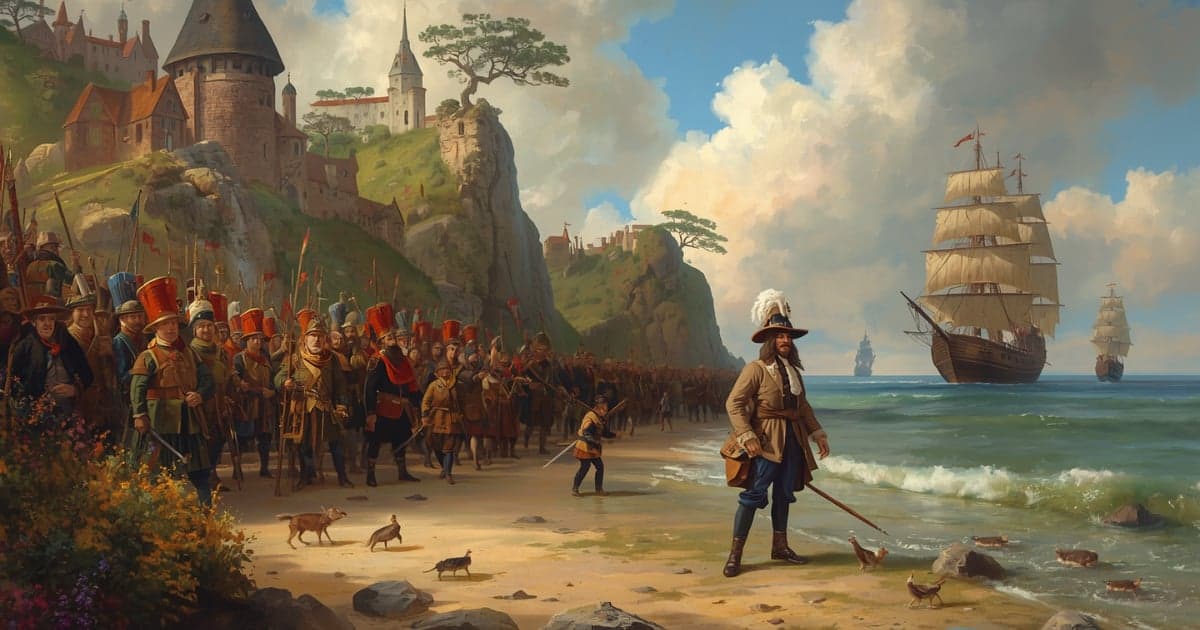
HOW CANDIDE MADE HIS ESCAPE FROM THE BULGARIANS, AND WHAT AFTERWARDS BECAME OF HIM. There was never anything so gallant, so spruce, so brilliant, and so well disposed as the two armies. Trumpets, fifes, hautboys, drums, and cannon made music such as Hell itself had never heard. The cannons first of all laid flat about six thousand men on each side; the muskets swept away from this best of worlds nine or ten thousand ruffians who infested its surface. The bayonet was also a sufficient reason for the death of several thousands. The whole might amount to thirty thousand souls.…
Public-domain chapter text, formatted for reading.
Master this chapter. Complete your experience
Purchase the complete book to access all chapters and support classic literature
Available in paperback, hardcover, and e-book formats
Now let's explore the literary elements.
Key Quotes & Analysis
"There was never anything so gallant, so spruce, so brilliant, and so well disposed as the two armies."
Context: Opening description of the battle that's about to kill thirty thousand people
Pure sarcasm. Voltaire uses beautiful, elegant language to describe something horrific. The contrast between the pretty words and ugly reality shows how society romanticizes violence.
In Today's Words:
After kindness from a stranger you cannot explain, Pure sarcasm. Voltaire uses beautiful, elegant language to describe something horrific. The contrast between the pretty words and ugly reality shows how society romanticizes violence. Notice whether you are absorbing comfort or testing it against evidence. Ask who profits when suffering gets renamed as progress.
"Candide, who trembled like a philosopher, hid himself as well as he could during this heroic butchery."
Context: As Candide watches the battle unfold
The phrase 'trembled like a philosopher' mocks intellectual types who theorize about war from safety. 'Heroic butchery' combines noble and brutal words to show war's true nature.
In Today's Words:
When the system explains suffering instead of reducing it, The phrase 'trembled like a philosopher' mocks intellectual types who theorize about war from safety. 'Heroic butchery' combines noble and brutal words to show war's true nature. Voltaire keeps asking who benefits from the explanation. Ask who profits when suffering gets renamed as progress.
"HOW CANDIDE MADE HIS ESCAPE FROM THE BULGARIANS, AND WHAT AFTERWARDS BECAME OF HIM."
Context: From War's True Face
This line marks a turn where private feeling collides with the roles each character is trying to maintain.
In Today's Words:
When a comforting theory meets a brutal fact, This line marks a turn where private feeling collides with the roles each character is trying to maintain. The joke is sharp because the pattern still runs modern institutions. Ask who profits when suffering gets renamed as progress.
"Trumpets, fifes, hautboys, drums, and cannon made music such as Hell itself had never heard."
Context: From War's True Face
This line marks a turn where private feeling collides with the roles each character is trying to maintain.
In Today's Words:
If you have ever been punished for trusting the official story, This line marks a turn where private feeling collides with the roles each character is trying to maintain. Practical wisdom starts when philosophy stops performing. Ask who profits when suffering gets renamed as progress.
Thematic Threads
Class
In This Chapter
Candide's aristocratic education becomes worthless in the real world—his refined upbringing can't help him navigate actual hardship
Development
Evolved from castle privilege to harsh reality of being powerless and homeless
In Your Life:
Your expensive degree might mean nothing when you're actually trying to solve problems at work
Identity
In This Chapter
Candide's identity as an optimistic gentleman crumbles as he witnesses mass slaughter and religious cruelty
Development
Continues from losing his castle identity—now losing his philosophical identity too
In Your Life:
When your core beliefs about yourself or the world get challenged, you might not know who you are anymore
Social Expectations
In This Chapter
Religious leaders preach charity but practice cruelty, while an outsider Anabaptist shows genuine kindness
Development
Introduced here—the gap between what institutions claim and what they deliver
In Your Life:
The people who talk loudest about values often practice them least, while quiet helpers do the real work
Human Relationships
In This Chapter
Authentic connection comes from James the Anabaptist who acts from conscience, not the preacher who acts from doctrine
Development
Introduced here—genuine vs. performative human connection
In Your Life:
Real friends help without asking what you believe; fake ones demand loyalty tests first
Personal Growth
In This Chapter
Candide begins questioning Pangloss's teachings but isn't ready to abandon them completely
Development
Continues from earlier doubt—cracks widening in his certainty
In Your Life:
Growth often means holding onto old beliefs while slowly recognizing they might be wrong
You now have the context. Time to form your own thoughts.
Discussion Questions
This is not a test. Five prompts guide you through the chapter, from how it opens to how it closes, so you notice context and rhythm rather than facts to memorize. Sit with each question in your own words. When you see "One way to read it," treat it as a starting point, not the only answer.
- 1
What happens in the opening of "War's True Face" when Candide witnesses his first real battle and discovers that war...?
analysis • surfaceOne way to read it
Voltaire opens by showing Candide witnesses his first real battle and discovers that war isn't the glorious spectacle... before Candide's naive faith is tested further.
- 2
Why does the middle of "War's True Face" turn on A preacher who spent an hour lecturing about charity refuses Candide...?
analysis • mediumOne way to read it
The chapter escalates when A preacher who spent an hour lecturing about charity refuses Candide bread because he..., exposing the gap between Pangloss's theory and lived catastrophe.
- 3
Where do you see the illusion collapse in modern workplaces, politics, or family life?
application • mediumOne way to read it
One reading: the same pattern appears when institutions explain harm instead of reducing it.
- 4
If you were Candide in the closing pressure of "War's True Face", what would you do differently?
application • deepOne way to read it
A practical response is to act on evidence before rebuilding a theory that makes the harm sound necessary.
- 5
What does "War's True Face" suggest about trusting philosophies that cannot survive bad evidence?
reflection • deepOne way to read it
It suggests that any worldview that cannot absorb real suffering is protecting someone else's comfort.
Critical Thinking Exercise
Reality Check Your Assumptions
Think of an institution or belief system you were taught to respect—your workplace, a political party, a church, the military, higher education. Write down three things you were told this institution stands for. Then write down three things you've actually witnessed this institution do. Look for gaps between the promises and the practice.
Consider:
- •Focus on what you've personally observed, not what others have told you
- •Consider who benefits when you believe the official story versus the reality
- •Notice if questioning these beliefs makes you uncomfortable—that discomfort often signals important truths
Journaling Prompt
Write about a time when reality forced you to abandon a comfortable belief. How did you rebuild your understanding, and what did you learn about distinguishing truth from wishful thinking?
Coming Up Next...
Chapter 4: When Your Teacher Falls Apart
A diseased beggar approaches Candide, barely recognizable but somehow familiar. This chance encounter will shatter everything Candide thought he knew about his past and his teacher's philosophy.