
The Bhagavad Gita
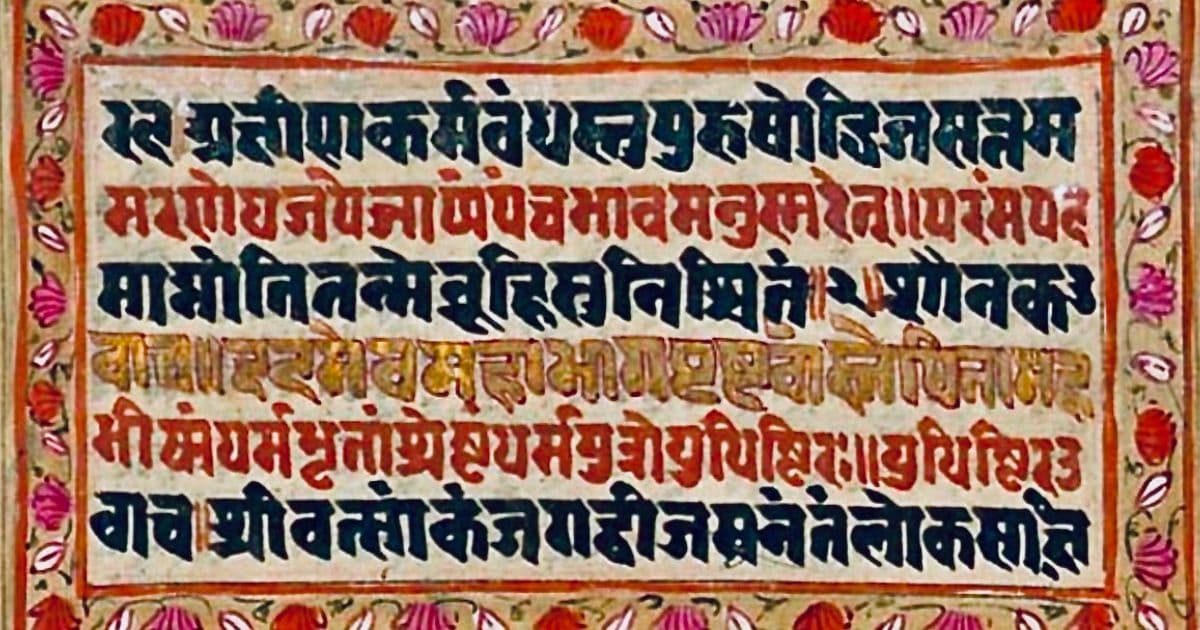
The Bhagavad Gita
A Brief Description
Arjuna is one of the greatest warriors alive. He has trained his entire life for this battle. Then, as two armies face each other across the field of Kurukshetra, he looks at the enemy line and sees his own teachers, cousins, and closest friends. His hands go slack. His bow drops. He cannot fight, and he no longer knows if he even should.
What follows is not a battle but a conversation. For eighteen chapters, Arjuna's charioteer Krishna answers the one question that stops every thoughtful person at the most critical moment of their life: how do you act rightly when every choice carries consequences you cannot fully control or predict?
Krishna does not give Arjuna an easy answer. He gives him a complete philosophy of life. Do your duty without attachment to the outcome. Act from your deepest nature, not from fear or desire for reward. Understand the difference between what is permanent and what is temporary. Know that the soul cannot be destroyed, only transformed. These are not abstract spiritual concepts; they are practical instructions for moving through an impossible situation without losing yourself in the process.
The Bhagavad Gita is the oldest, most precise manual for decision-making under pressure ever written. You will recognize its patterns everywhere: the paralysis that hits when the stakes are highest, the temptation to avoid hard choices by doing nothing, the confusion between what you want and what your role demands. Krishna's teachings on action without ego, duty over comfort, and equanimity under pressure apply as directly to a career crisis, a broken relationship, or a moral dilemma today as they did on an ancient battlefield three thousand years ago.
This is a book about what to do when you already know what you have to do, and still cannot make yourself do it.
Essential Life Skills Deep Dive
Explore chapter-by-chapter breakdowns of the essential life skills taught in this classic novel.
Acting Without Attachment to Results
8 chapters on the Gita's most practical teaching — how to act with full commitment while releasing the ego's grip on outcome, from the battlefield of Kurukshetra to your daily decisions.
Moving Through Paralysis
8 chapters using Arjuna's battlefield collapse as the definitive case study — and Krishna's systematic response as the most complete treatment of how to act when everything feels impossible.
The Three Forces That Drive You
8 chapters on sattva, rajas, and tamas — the Gita's most diagnostic framework, mapping three forces that shape everything from what you eat to how you act to the quality of your faith.
The Stable Mind
8 chapters on the sthitaprajna — the person of steady wisdom — what equanimity under pressure actually looks like, and the three paths (discipline, understanding, devotion) that build it.
Knowing What Is Actually Yours
8 chapters on the self vs non-self distinction — what persists through change, what you are not, and what this means for how you live and what you fear.
Choosing a Path and Walking It
8 chapters on karma, jnana, dhyana, and bhakti yoga — and the Gita's most liberating teaching: sincere commitment to any one of these paths leads to the same destination.
Essential Skills
Life skills and patterns this book helps you develop—drawn from its themes and characters.
Acting Without Attachment
Learn to do what's required without becoming enslaved to outcomes you can't control
Finding Clarity Under Pressure
Develop the mental stillness to see clearly when stakes are highest and emotions run hottest
Understanding Your Duty
Distinguish between what you want to do, what you're afraid to do, and what you're actually called to do
Overcoming Decision Paralysis
Break through the freeze that hits when every choice carries real costs
Separating Self from Role
Understand the difference between who you are and what your position requires of you
Equanimity in Crisis
Cultivate the calm that comes not from avoiding difficulty but from facing it without being consumed
Table of Contents
The Warrior's Crisis of Conscience
A blind king asks his minister what is happening on the sacred plain of Kurukshetra. Sanjaya reports...
When Duty Conflicts with Love
Sanjaya tells the blind king how Krishna rebukes the weeping prince: weakness shames a warrior and b...
The Path of Righteous Action
Arjuna presses Krishna: if meditation is nobler, why push him into this dreadful war? He wants one c...
The Religion of Knowledge
Krishna opens the chapter of knowledge by tracing an ancient line: he taught Vivaswata, who gave the...
Working Without Attachment
Arjuna asks again which path is better: ceasing from works or holy service through work. Krishna ans...
The Art of Self-Mastery
Real renunciation is not quitting your post. Krishna says whoever does rightful work without chasing...
The Divine in Everything
Set your soul on Krishna, keep yoga, make Him your refuge: that is how Arjuna will come to perfect h...
The Ultimate Questions About Life and Death
Arjuna demands definitions: What is Brahma? Soul of Souls? Karma? Lord of Lives, Lord of Gods? How i...
The Royal Secret of Divine Love
Krishna opens the kingly mystery: royal lore that purges sin and sets free from ills, plain and inex...
The Divine in Everything
Krishna speaks for Arjuna's peace: neither gods nor kingly Rishis know His full Nature, though He ma...
The Vision of Universal Form
Arjuna has heard enough theory; he wants to see Krishna's glory with his own eyes, not hear about it...
The Path of Loving Devotion
After the cosmic vision, Arjuna asks a practical question: is it better to worship Krishna revealed ...
The Field and the Knower
Arjuna wants the distinction between life that seems and the soul that sees. Krishna teaches: flesh...
The Three Forces That Shape Us
Krishna calls this the wisdom of all wisdoms: those who rely on it pass to perfectness and do not su...
The Upside-Down Tree of Life
Krishna teaches the Aswattha, the holy banyan with roots above and branches below: its leaves are hy...
Two Paths: Divine and Destructive
Krishna gives Arjuna a field guide to two natures stamped on every life: divine marks that loosen th...
The Three Types of Faith
Arjuna asks what becomes of people who ignore the Shastras yet worship in faith: are they Sattva, Ra...
The Ultimate Teaching: Surrender and Liberation
Arjuna asks the difference between Sannyas and Tyaga. Krishna teaches: Sannyas forsakes desire-born ...
About Vyasa
Published -400
The Bhagavad Gita is attributed to the sage Vyasa, the legendary compiler of the Mahabharata, the epic poem in which the Gita appears as a dialogue in the sixth book. Scholars date the composition of the Gita to roughly 400 to 200 BCE, though it draws on philosophical traditions significantly older. Vyasa is considered in Hindu tradition to be one of the seven immortals, a figure both historical and mythological, credited with organizing the Vedas and composing the Puranas alongside the Mahabharata.
The Gita was not widely known in the Western world until 1785, when Charles Wilkins produced the first English translation. It became a transformative text for the Romantic and Transcendentalist movements, influencing Emerson, Thoreau, and later Tolstoy. In the twentieth century, it shaped figures as different as Mahatma Gandhi, who called it his "spiritual dictionary," and Robert Oppenheimer, who famously quoted it upon witnessing the first nuclear test.
What makes the Gita enduring is not its religious context but its psychological precision. It addresses a problem that has no clean solution: how to act decisively when the consequences of your actions are bound up with people you love, institutions you have built, and values that appear to be in genuine conflict. Krishna's answer, act from duty without attachment to outcomes, remains the most rigorous framework ever articulated for maintaining clarity under conditions of maximum moral complexity.
Why This Author Matters Today
Reading Vyasa is an act of self-discovery — one that tends to be more unsettling, and more rewarding, than you expect. Their work doesn't offer easy answers. It offers something rarer: the right questions. Questions about what we owe each other, what we owe ourselves, and what kind of person we are quietly becoming through the choices we make every day.
What makes Vyasa indispensable isn't just their insight into human nature — it's their honesty about its contradictions. They understood that people are capable of extraordinary courage and ordinary cowardice, often in the same breath. That we can hold convictions firmly and abandon them the moment they cost us something. That the gap between who we think we are and who we actually are is where most of life's real drama lives.
In an age of noise, distraction, and the constant pressure to perform certainty we don't feel,Vyasa is a corrective. Their pages slow you down and ask you to look more carefully — at the world, yes, but especially at yourself. Few writers have done more to show us that thinking well is not an academic exercise but a survival skill, and that the examined life is not a luxury but the only honest way to live.
Wide Reads is different.
not a sparknotes, nor a cliffnotes
Two ways in
Read & listen to the summary
Walk with the characters. Hear the story told completely — chapter by chapter, with audio. Feel what they feel. The meaning arrives because you experienced it, not because someone listed bullet points. Every chapter has a summary that speaks.
Start with this.
Read the original text
The manuscript. The actual words the author wrote. Every book on Wide Reads includes the original text alongside the summary — so you can read Austen as Austen wrote her, Dostoevsky as he wrote his. Use the summary as a guide, then step into the source.
Then step into the source.
Either way, the door opens inward.
As you enter the realm — each chapter goes deeper
— and most of all, Why does this matter?
Get the Full Book
Purchase the complete book to access all chapters and support classic literature
Available in paperback, hardcover, and e-book formats
You Might Also Like




Free to read • No account required