Chapter 11
Agamemnon's Glory and Wounded Pride
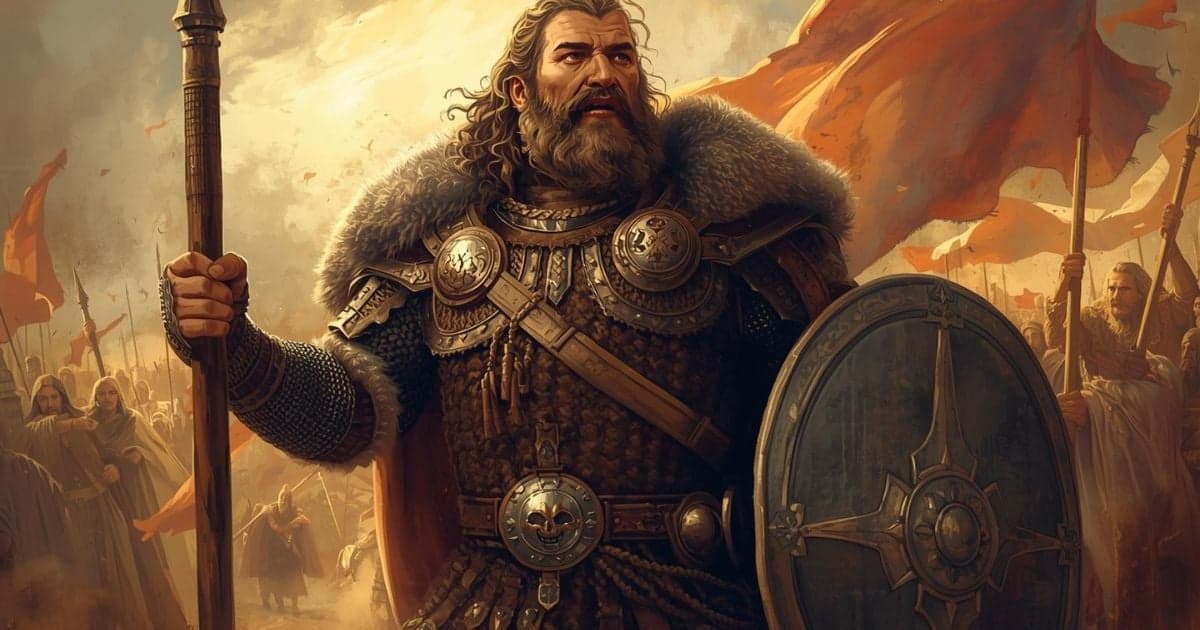
ARGUMENT THE THIRD BATTLE, AND THE ACTS OF AGAMEMNON. Agamemnon, having armed himself, leads the Grecians to battle; Hector prepares the Trojans to receive them, while Jupiter, Juno, and Minerva give the signals of war. Agamemnon bears all before him and Hector is commanded by Jupiter (who sends Iris for that purpose) to decline the engagement, till the king shall be wounded and retire from the field. He then makes a great slaughter of the enemy. Ulysses and Diomed put a stop to him for a time but the latter, being wounded by Paris, is obliged to desert his companion,…
Public-domain chapter text, formatted for reading.
Master this chapter. Complete your experience
Purchase the complete book to access all chapters and support classic literature
Available in paperback, hardcover, and e-book formats
Now let's explore the literary elements.
Key Quotes & Analysis
"He then makes a great slaughter of the enemy."
Context: A pivotal line from the opening of the chapter
The narrator's clinical description of Agamemnon's battlefield dominance reveals how violence becomes mechanized when leaders finally engage directly. His systematic slaughter demonstrates that royal authority means nothing without the willingness to personally risk everything alongside one's followers.
In Today's Words:
When the CEO finally rolls up his sleeves and works the front lines, his efficiency becomes ruthless. Every decision he makes eliminates competition, proving that real leadership requires getting your hands dirty in the trenches with your team. Naming the pattern early matters when pride keeps both sides locked in a move they cannot undo.
"Thy country’s friend; and virtuous, though in vain!"
Context: A pivotal line from the middle of the chapter
This lament captures the tragic irony of good intentions failing in crisis moments. Even virtuous efforts become meaningless when circumstances overwhelm individual merit, showing how character alone cannot guarantee success in chaotic situations.
In Today's Words:
You tried to do the right thing and meant well, but sometimes good intentions aren't enough when everything falls apart. Being a decent person doesn't protect you from getting crushed by forces beyond your control. Honor cultures still punish the person who reads restraint as weakness until the cost is public.
"Oh, turn to arms; ’tis Ajax claims your aid."
Context: A pivotal line from the closing third of the chapter
Ajax's desperate call for reinforcement shows how even the strongest individuals reach their breaking point when facing overwhelming odds. His plea reveals that heroic endurance has limits and that survival often depends on others answering the call for help.
In Today's Words:
The strongest person on your team is drowning and needs backup immediately. Even your most reliable performer can't handle everything alone when the pressure becomes too intense and the workload becomes impossible. That pressure appears whenever power meets grief and neither side can admit what they have lost.
"Whate’er thy will, Patroclus shall obey."
Context: A pivotal line from the closing third of the chapter
Patroclus's immediate compliance demonstrates the power of loyalty between close friends, where one person's request becomes another's unquestioned mission. His response shows how deep relationships create automatic commitment that bypasses rational calculation of personal risk.
In Today's Words:
When your best friend asks for something, you don't hesitate or negotiate terms. True friendship means saying yes first and figuring out the consequences later, because their needs automatically become your priorities. Honor cultures still punish the person who reads restraint as weakness until the cost is public.
Thematic Threads
Leadership
In This Chapter
Agamemnon's battlefield leadership proves his worth but creates dangerous dependency when he falls
Development
Evolution from his earlier failures—now we see both the power and peril of effective leadership
In Your Life:
You might see this when you become the go-to person at work and realize everyone depends on you alone.
Class
In This Chapter
The king must prove himself through personal combat, not just political maneuvering
Development
Deepened from earlier themes—class requires performance, not just position
In Your Life:
You might see this when your job title doesn't match what you actually have to prove daily.
Identity
In This Chapter
Agamemnon transforms from political leader to warrior hero, but at great cost
Development
Continues the theme of identity proving—but shows the price of transformation
In Your Life:
You might see this when finally stepping up in a crisis changes how others see and depend on you.
Human Relationships
In This Chapter
The army's morale completely depends on seeing their leaders fight alongside them
Development
Builds on earlier relationship dynamics—trust requires visible commitment
In Your Life:
You might see this when your team needs to see you struggle with them, not just direct from above.
Social Expectations
In This Chapter
A king must lead from the front in battle to maintain legitimacy and inspire troops
Development
Reinforces earlier themes about proving worth through action, not just authority
In Your Life:
You might see this when your role requires you to do the hard work yourself to maintain credibility.
You now have the context. Time to form your own thoughts.
Discussion Questions
This is not a test. Five prompts guide you through the chapter, from how it opens to how it closes, so you notice context and rhythm rather than facts to memorize. Sit with each question in your own words. When you see "One way to read it," treat it as a starting point, not the only answer.
- 1
What happens to the Greek army when Agamemnon is wounded and leaves the battlefield?
analysis • surfaceOne way to read it
Momentum reverses quickly as Hector rallies the Trojans and wounded leaders multiply on the Greek side.
- 2
How does Nestor use Patroclus's visit to push Achilles back toward the war?
analysis • mediumOne way to read it
He tells war stories and lists the wounded chiefs to show that withdrawal has become catastrophic for Greece.
- 3
Why does Agamemnon refuse to spare the sons of Antimachus?
application • mediumOne way to read it
He treats their plea as proof of an old council enemy's bloodline and chooses vengeance over ransom.
- 4
Where have you seen a team thrive only while one person carried impossible load?
application • deepOne way to read it
Strong answers describe a workplace or family where success vanished the moment the key person was absent or injured.
- 5
What does Odysseus's stand alone against the Trojans suggest about courage without an audience?
reflection • deepOne way to read it
He chooses to fight because retreat would shame him, showing that character appears when support is gone.
Critical Thinking Exercise
Build Your Backup System
Think about one area where people depend on you heavily - at work, at home, or in your community. Map out what would happen if you suddenly couldn't fulfill that role for a week. Then design a simple backup system that could keep things running without you.
Consider:
- •What specific knowledge or skills do you have that others don't?
- •Who could you train to handle the most critical parts of your role?
- •What simple systems or documentation could you create now, before a crisis hits?
Journaling Prompt
Write about a time when you or your family/workplace was thrown into chaos because one key person was suddenly unavailable. What would have made that situation easier to handle?
Coming Up Next...
Chapter 12: Breaking Through the Wall
As the Greek defenses crumble and their greatest warriors fall wounded, Patroclus returns from his mission with devastating news about the state of their army. His report will force Achilles to confront a terrible choice between his wounded pride and his loyalty to his dying comrades.