Wide Reads
Literature MattersLife IndexEducators
Sign in
Where to Begin
The Count of Monte Cristo - Toxicology

Alexandre Dumas

The Count of Monte Cristo

Toxicology

Home›Books›The Count of Monte Cristo›Chapter 52
Previous
52 of 117
Next

Summary

Toxicology

The Count of Monte Cristo by Alexandre Dumas

0:000:00
Listen to Next Chapter

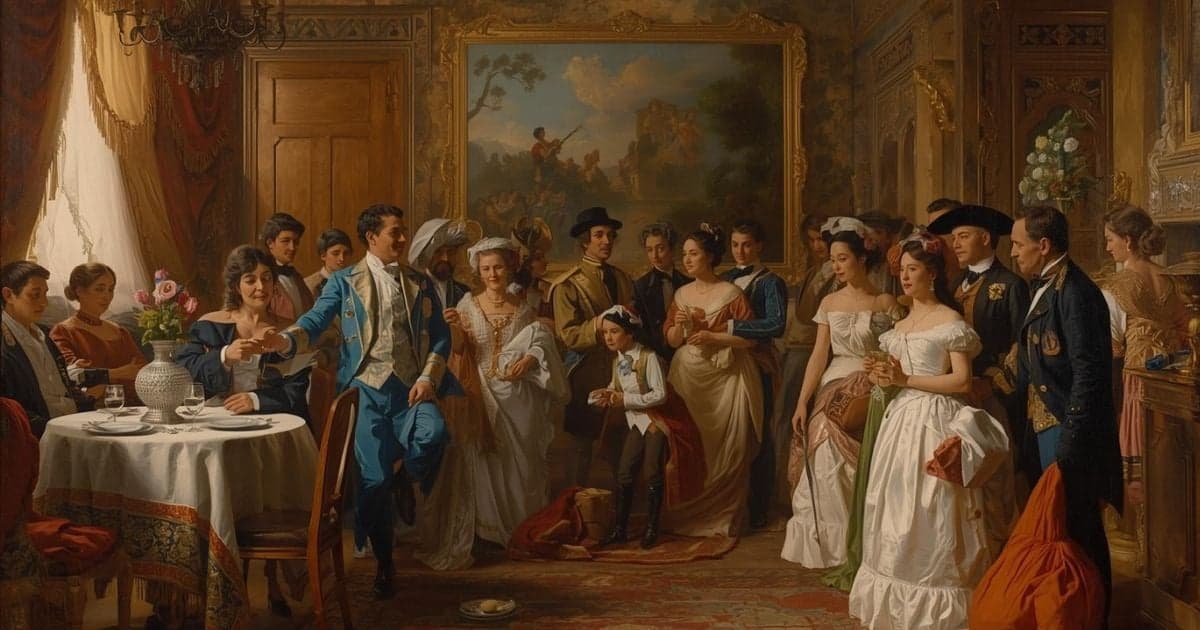
Franz d'Épinay and Albert de Morcerf attend the opera in Rome, where they encounter the mysterious Count of Monte Cristo in his luxurious box. The Count appears to know everyone of importance and displays an almost supernatural awareness of people's secrets and histories. He casually mentions details about various attendees that he shouldn't possibly know, creating an atmosphere of intrigue and unease. Albert is fascinated by the Count's wealth and sophistication, while Franz feels increasingly uncomfortable with the man's penetrating gaze and cryptic comments. The Count demonstrates his immense influence by effortlessly arranging introductions and favors, suggesting he has connections that reach into the highest levels of society. This scene establishes the Count as a figure of immense power and mystery, someone who operates on a different level from ordinary people. For Albert, this meeting represents an exciting brush with sophistication and danger. For Franz, it's a warning sign that something isn't quite right about this enigmatic nobleman. The opera setting itself becomes symbolic—just as the performance on stage is carefully orchestrated drama, so too does the Count seem to be orchestrating events in real life. This chapter shows how the Count uses social situations to gather information and assess potential allies or enemies. His ability to see through people's facades and know their secrets makes him both fascinating and terrifying. The evening reveals that the Count isn't just wealthy—he's someone who understands human nature deeply and uses that knowledge strategically. This meeting will prove pivotal in drawing both young men into the Count's elaborate web of revenge and justice.

Coming Up in Chapter 53

The Count extends an invitation that Albert eagerly accepts, despite Franz's growing reservations. What seems like a generous gesture from a new acquaintance may actually be the first move in a carefully planned game.

Share it with friends

Previous ChapterNext Chapter
GO ADS FREE — JOIN US
Original text
complete·6,271 words
T

was really the Count of Monte Cristo who had just arrived at Madame de Villefort’s for the purpose of returning the procureur’s visit, and at his name, as may be easily imagined, the whole house was in confusion.

Madame de Villefort, who was alone in her drawing-room when the count was announced, desired that her son might be brought thither instantly to renew his thanks to the count; and Edward, who heard this great personage talked of for two whole days, made all possible haste to come to him, not from obedience to his mother, or out of any feeling of gratitude to the count, but from sheer curiosity, and that some chance remark might give him the opportunity for making one of the impertinent speeches which made his mother say:

“Oh, that naughty child! But I can’t be severe with him, he is really so bright.”

After the usual civilities, the count inquired after M. de Villefort.

“My husband dines with the chancellor,” replied the young lady; “he has just gone, and I am sure he’ll be exceedingly sorry not to have had the pleasure of seeing you before he went.”

1 / 37

Master this chapter. Complete your experience

Purchase the complete book to access all chapters and support classic literature

Read Free on GutenbergBuy at Powell'sBuy on Amazon

As an Amazon Associate, we earn a small commission from qualifying purchases at no additional cost to you.

Available in paperback, hardcover, and e-book formats

GO ADS FREE — JOIN US

Why This Matters

Connect literature to life

Skill: Reading Power Dynamics

This chapter teaches how to recognize when someone has information advantage over you and how to level the playing field.

Practice This Today

This week, notice when conversations feel one-sided—when you're sharing but they're only asking questions—and start asking your own questions back.

GO ADS FREE — JOIN US

Now let's explore the literary elements.

Key Quotes & Analysis

"The Count seemed to have the faculty of reading the thoughts of all around him."

— Narrator

Context: Describing the Count's almost supernatural ability to understand people

This establishes the Count as someone operating on a different level from ordinary people. His ability to see through facades and understand motivations makes him both fascinating and dangerous to those around him.

In Today's Words:

This guy could read people like they had their thoughts written on their foreheads.

"I have traveled much, and the world is small when one has money and time."

— The Count of Monte Cristo

Context: Explaining how he knows so much about different people and places

Reveals the Count's philosophy that wealth and leisure create access to information and influence. This seemingly casual comment hints at the vast resources he commands and his patient, methodical approach to gathering intelligence.

In Today's Words:

When you're rich and have time on your hands, you'd be amazed what you can find out about people.

"There was something in his smile that made Franz feel uneasy."

— Narrator

Context: Franz's reaction to the Count's demeanor during their conversation

Franz's instinctive discomfort serves as a warning to readers that beneath the Count's charm lies something more sinister. This reaction shows that some people can sense danger even when they can't identify its source.

In Today's Words:

Something about the way he smiled gave Franz the creeps, though he couldn't put his finger on why.

Thematic Threads

Class

In This Chapter

The Count's mysterious wealth and connections place him above normal social rules and scrutiny

Development

Building from earlier displays of wealth to show how money creates access to information and influence

In Your Life:

You might notice how people with resources get better service, more respect, and access to information others don't receive

Identity

In This Chapter

The Count carefully controls what others know about him while seeming to know everything about them

Development

Deepening the mystery around his true identity and past

In Your Life:

You might recognize how some people seem to know everything about you while you know nothing real about them

Social Expectations

In This Chapter

Albert is drawn to the Count's sophistication while Franz senses something wrong beneath the surface

Development

Continuing the theme of how appearances can deceive in high society

In Your Life:

You might notice how some people seem too good to be true or how your gut feelings conflict with what others find impressive

Power Dynamics

In This Chapter

The Count demonstrates his influence by effortlessly arranging introductions and favors

Development

Introduced here as a new dimension of how the Count operates

In Your Life:

You might see how some people can make things happen with a phone call while others struggle through bureaucracy

Human Relationships

In This Chapter

The evening shows how the Count uses social situations to assess people as potential allies or enemies

Development

Building on earlier themes of how relationships can be strategic rather than genuine

In Your Life:

You might recognize when someone is evaluating your usefulness rather than genuinely getting to know you

GO ADS FREE — JOIN US

You now have the context. Time to form your own thoughts.

Discussion Questions

  1. 1

    What specific behaviors does the Count use to demonstrate his power and knowledge at the opera?

    analysis • surface
  2. 2

    Why do Franz and Albert react so differently to the Count's mysterious knowledge about other people?

    analysis • medium
  3. 3

    Where have you seen someone use the 'listen more, reveal less' strategy to gain advantage in your workplace or social circles?

    application • medium
  4. 4

    If you were Albert or Franz in this situation, how would you protect yourself from someone gathering information about you?

    application • deep
  5. 5

    What does this scene reveal about why people are drawn to mysterious individuals, even when they sense danger?

    reflection • deep

Critical Thinking Exercise

10 minutes

Map Your Information Footprint

Think about your last week of conversations at work, with family, or on social media. List what personal information you revealed versus what you learned about others. Then identify one upcoming situation where you could practice the Count's strategy of asking questions and listening more than sharing.

Consider:

  • •Notice which topics make you want to overshare and why
  • •Consider how much strangers or acquaintances actually need to know about your personal life
  • •Think about people in your life who seem to know everyone's business but rarely share their own

Journaling Prompt

Write about a time when you shared too much personal information and later regretted it. What would you do differently now, and how could you have maintained more mystery while still being authentic?

GO ADS FREE — JOIN US

Coming Up Next...

Chapter 53: Robert le Diable

The Count extends an invitation that Albert eagerly accepts, despite Franz's growing reservations. What seems like a generous gesture from a new acquaintance may actually be the first move in a carefully planned game.

Continue to Chapter 53
Previous
Pyramus and Thisbe
Contents
Next
Robert le Diable

Continue Exploring

The Count of Monte Cristo Study GuideTeaching ResourcesEssential Life IndexBrowse by ThemeAll Books
Moral Dilemmas & EthicsPower & CorruptionIdentity & Self-Discovery

You Might Also Like

Les Misérables: Essential Edition cover

Les Misérables: Essential Edition

Victor Hugo

Explores justice & fairness

The Strange Case of Dr Jekyll and Mr Hyde cover

The Strange Case of Dr Jekyll and Mr Hyde

Robert Louis Stevenson

Explores power & authority

Crime and Punishment cover

Crime and Punishment

Fyodor Dostoevsky

Explores suffering & resilience

Moby-Dick cover

Moby-Dick

Herman Melville

Explores suffering & resilience

Browse all 47+ books
GO ADS FREE — JOIN US

Share This Chapter

Know someone who'd enjoy this? Spread the wisdom!

TwitterFacebookLinkedInEmail

Read ad-free with Prestige

Get rid of ads, unlock study guides and downloads, and support free access for everyone.

Subscribe to PrestigeCreate free account
Intelligence Amplifier
Intelligence Amplifier™Powering Wide Reads

Exploring human-AI collaboration through books, essays, and philosophical dialogues. Classic literature transformed into navigational maps for modern life.

2025 Books

→ The Amplified Human Spirit→ The Alarming Rise of Stupidity Amplified→ San Francisco: The AI Capital of the World
Visit intelligenceamplifier.org
hello@widereads.com

WideReads Originals

→ You Are Not Lost→ The Last Chapter First→ The Lit of Love→ Wealth and Poverty→ 10 Paradoxes in the Classics · coming soon
Arvintech
arvintechAmplify your Mind
Visit at arvintech.com

Navigate

  • Home
  • Library
  • Essential Life Index
  • How It Works
  • Subscribe
  • Account
  • About
  • Contact
  • Authors
  • Suggest a Book
  • Landings

Made For You

  • Students
  • Educators
  • Families
  • Readers
  • Literary Analysis
  • Finding Purpose
  • Letting Go
  • Recovering from a Breakup
  • Corruption
  • Gaslighting in the Classics

Newsletter

Weekly insights from the classics. Amplify Your Mind.

Legal

  • Privacy Policy
  • Terms of Service
  • Cookie Policy
  • Accessibility

Why Public Domain?

We focus on public domain classics because these timeless works belong to everyone. No paywalls, no restrictions—just wisdom that has stood the test of centuries, freely accessible to all readers.

Public domain books have shaped humanity's understanding of love, justice, ambition, and the human condition. By amplifying these works, we help preserve and share literature that truly belongs to the world.

A Pilgrimage

Powell's City of Books

Portland, Oregon

If you ever find yourself in Portland, walk to the corner of Burnside and 10th. The building takes up an entire city block. Inside is over a million books, new and used on the same shelf, organized by color-coded rooms with names like the Rose Room and the Pearl Room. You can lose an afternoon. You can lose a weekend. You will find a book you have been looking for your whole life, and three you did not know existed.

It is a pilgrimage. We cannot find a bookstore like it anywhere on earth. If you read the classics, and you ever get the chance, go. It belongs on every reader's bucket list.

Visit powells.com

We are not in any way affiliated with Powell's. We are just a very big fan.

© 2026 Wide Reads™. All Rights Reserved.

Intelligence Amplifier™ and Wide Reads™ are proprietary trademarks of Arvin Lioanag.

Copyright Protection: All original content, analyses, discussion questions, pedagogical frameworks, and methodology are protected by U.S. and international copyright law. Unauthorized reproduction, distribution, web scraping, or use for AI training is strictly prohibited. See our Copyright Notice for details.

Disclaimer: The information provided on this website is for general informational and educational purposes only and does not constitute professional, legal, financial, or technical advice. While we strive to ensure accuracy and relevance, we make no warranties regarding completeness, reliability, or suitability. Any reliance on such information is at your own risk. We are not liable for any losses or damages arising from use of this site. By using this site, you agree to these terms.