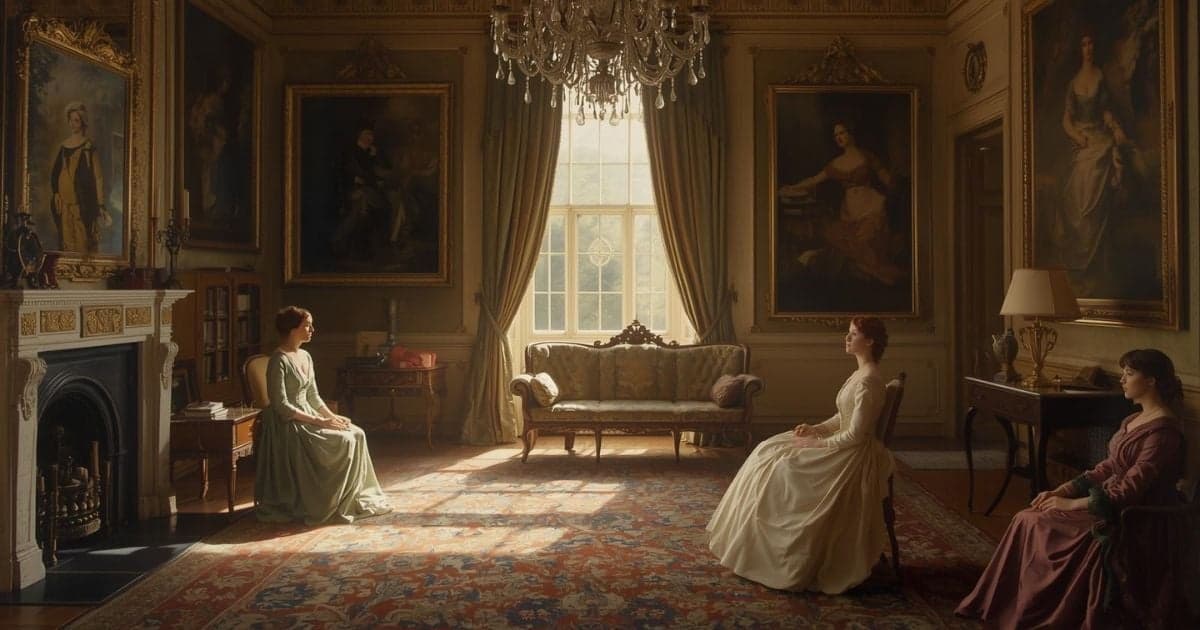
Chapter 20
Jane Fairfax's Hidden Story
Jane Fairfax was an orphan, the only child of Mrs. Bates’s youngest daughter. The marriage of Lieut. Fairfax of the ——regiment of infantry, and Miss Jane Bates, had had its day of fame and pleasure, hope and interest; but nothing now remained of it, save the melancholy remembrance of him dying in action abroad—of his widow sinking under consumption and grief soon afterwards—and this girl. By birth she belonged to Highbury: and when at three years old, on losing her mother, she became the property, the charge, the consolation, the foundling of her grandmother and aunt, there had seemed every…
Public-domain chapter text, formatted for reading.
Master this chapter. Complete your experience
Purchase the complete book to access all chapters and support classic literature
Available in paperback, hardcover, and e-book formats
Now let's explore the literary elements.
Key Quotes & Analysis
"With the fortitude of a devoted novitiate, she had resolved at one-and-twenty to complete the sacrifice, and retire from all the pleasures of life, of rational intercourse, equal society, peace and hope, to penance and mortification for ever."
Context: Jane Fairfax facing work as a governess
Jane names governess life as social exile. Her education raised her for company she will soon have to leave.
In Today's Words:
Jane Fairfax treats turning twenty-one as the moment to accept governess life, giving up equal society, ease, and hope for what she calls penance forever. She has prepared herself like someone taking lifelong vows rather than simply changing employment. Her London education only sharpened the loss ahead.
"Mr. Knightley had once told her it was because she saw in her the really accomplished young woman, which she wanted to be thought herself"
Context: Emma's reasons for disliking Jane Fairfax
The narrator names the wound Emma will not admit. Jane embodies what Emma performs.
In Today's Words:
Mr Knightley once told Emma she disliked Jane because Jane is the truly accomplished young woman Emma wants to be thought herself. Emma denied it then, yet her conscience still cannot fully acquit her when Jane returns elegant and competent. That accusation still shadows every visit.
"she sat, during the first visit, looking at Jane Fairfax with twofold complacency; the sense of pleasure and the sense of rendering justice, and was determining that she would dislike her no longer."
Context: Emma's first visit after Jane's return
Admiration and guilt briefly align. Emma enjoys Jane's elegance and tells herself she is being fair.
In Today's Words:
During Jane Fairfax's first visit Emma watches her with double satisfaction, pleased by her elegance and proud of doing justice at last. She decides then that she will dislike Jane no longer and even pities her coming sacrifice. Compassion lasts only until the next provocation.
"not a syllable of real information could Emma procure as to what he truly was. “Was he handsome?”—“She believed he was reckoned a very fine young man.”"
Context: Emma questions Jane about Frank Churchill at Hartfield
Jane's smooth deflection restores Emma's suspicion. Politeness reads as artifice when Emma wants secrets.
In Today's Words:
When Emma asks Jane Fairfax about Frank Churchill, Jane answers only in generalities about manners and reputation at Weymouth. Emma cannot get one real syllable about what he truly is, and that reserve turns her charity cold again by evening. Emma ends the evening back in active dislike.
Thematic Threads
Class
In This Chapter
Jane's education without wealth creates impossible social position—too refined for working class, too poor for leisure class
Development
Deepens from earlier class observations—shows how education without money creates new form of social limbo
In Your Life:
You might feel this tension when your education or skills don't match your economic reality, leaving you between worlds.
Identity
In This Chapter
Emma's self-image as accomplished lady threatened by Jane's genuine refinement, forcing defensive reaction
Development
Continues Emma's identity struggles—now showing how external threats trigger internal defenses
In Your Life:
You might feel defensive when someone else's competence makes you question your own abilities or reputation.
Social Expectations
In This Chapter
Jane faces 'social death' as governess despite her accomplishments—education means nothing without independent wealth
Development
Expands on rigid social roles—shows how even exceptional merit can't overcome class barriers
In Your Life:
You might feel trapped by others' expectations about what your background 'should' limit you to achieving.
Human Relationships
In This Chapter
Emma's compassion turns to suspicion based entirely on her own insecurities, not Jane's actual behavior
Development
Builds on relationship patterns—shows how internal fears poison external connections
In Your Life:
You might find yourself suddenly critical of friends who achieve things you wanted but haven't accomplished.
Personal Growth
In This Chapter
Emma's inability to examine her own motives keeps her trapped in cycles of judgment and misunderstanding
Development
Continues growth theme—demonstrates how self-awareness gaps prevent emotional development
In Your Life:
You might stay stuck in negative patterns when you focus on others' flaws instead of examining your own reactions.
You now have the context. Time to form your own thoughts.
Discussion Questions
This is not a test. Five prompts guide you through the chapter, from how it opens to how it closes, so you notice context and rhythm rather than facts to memorize. Sit with each question in your own words. When you see "One way to read it," treat it as a starting point, not the only answer.
- 1
Why does Colonel Campbell take charge of Jane Fairfax's upbringing?
analysis • surfaceOne way to read it
He highly regarded her dead father, believed Fairfax saved his life during camp-fever, and later sought out the child to educate her when independence was impossible on her small inheritance.
- 2
What fate has Jane resolved to accept at one-and-twenty?
analysis • mediumOne way to read it
She means to begin work as a governess, giving up equal society and ease for what she calls a life of penance and mortification.
- 3
Why does Emma's warmth toward Jane fade after the Hartfield evening?
application • mediumOne way to read it
Jane's polite reserve on music, Weymouth, the Dixons, and Frank Churchill strikes Emma as affectation, and Emma returns to suspicion after briefly resolving to dislike her no longer.
- 4
What does Emma suspect Jane is hiding about Mr Dixon?
application • deepOne way to read it
Emma thinks Dixon may have nearly preferred Jane to Miss Campbell, or married for twelve thousand pounds, and that Jane's caution conceals more than preference.
- 5
When have you felt admiration turn into criticism without clear cause?
reflection • deepOne way to read it
One honest answer might recall a moment like Emma's, when another person's real competence made your own confidence feel suddenly thin.
Critical Thinking Exercise
Map Your Recognition Traps
Think of three people who irritate you or whom you've found yourself criticizing lately. For each person, write down what they do or have that bothers you. Then ask yourself: 'What does this person possess that I wish I had?' or 'What does their behavior say about my own choices?' Look for patterns in your answers.
Consider:
- •Your irritation might be information about where you want to grow
- •The stronger your negative reaction, the more likely it's about your own fears
- •Recognizing the pattern doesn't mean you have to like everyone, just understand your reactions
Journaling Prompt
Write about a time when you realized your dislike of someone was really about your own insecurities. How did that recognition change your relationship with that person or with yourself?
Coming Up Next...
Chapter 21: News and Uncomfortable Encounters
Chapter III opens the morning after Hartfield music: Mr Knightley praises Emma's attention to Jane Fairfax, then Miss Bates bursts in with news that Mr Elton is engaged to a Miss Hawkins of Bath at last.