Chapter 16
Huck and Jim face their biggest crisis yet when they realize they'v...
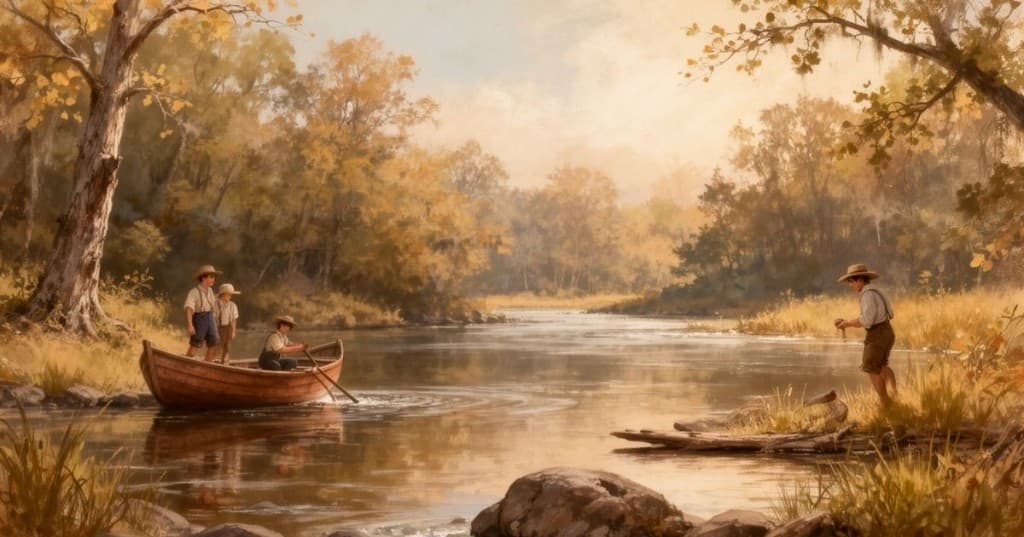
monstrous long raft that was as long going by as a procession. She had four long sweeps at each end, so we judged she carried as many as thirty men, likely. She had five big wigwams aboard, wide apart, and an open camp fire in the middle, and a tall flag-pole at each end. There was a power of style about her. It amounted to something being a raftsman on such a craft as that. We went drifting down into a big bend, and the night clouded up and got hot. The river was very wide, and was walled with…
Public-domain chapter text, formatted for reading.
Master this chapter. Complete your experience
Purchase the complete book to access all chapters and support classic literature
Available in paperback, hardcover, and e-book formats
Now let's explore the literary elements.
Key Quotes & Analysis
"But you knowed he was running for his freedom, and you could a paddled ashore and told somebody."
Context: Huck wrestles with helping Jim as they near Cairo and freedom
Conscience speaks in the voice of respectable law. Huck cannot dodge that he chose complicity once he understood Jim's goal was escape, not adventure.
In Today's Words:
Your inner voice keeps saying you knew exactly what you were doing and could have turned him in at any landing. Guilt lands hardest when you cannot pretend ignorance anymore. On the raft Huck discovers that lived experience can overturn years of teaching, especially when the person you were taught to fear turns out to
"He's white."
Context: Slave hunters ask whether the man on Huck's raft is white or Black
Two words decide Jim's fate. Huck almost betrays Jim, then lies to protect him, proving loyalty wins over the law he was taught to obey.
In Today's Words:
He said my companion was white. That lie was the moment he chose Jim over every rule St. Petersburg drilled into him. Readers still recognize the pattern when performance, politeness, or paperwork replace the simple humane move that would end the harm right now. Readers still recognize the pattern when performance, politeness, or paperwork replace
"Dat _wuz_ de smartes' dodge! I tell you, chile, I 'speck it save' ole Jim—ole Jim ain't going to forgit you for dat, honey."
Context: Jim heard Huck fool the hunters with the smallpox story
Jim praises the lie that saved him without knowing Huck nearly told the truth. The gap between Huck's inner war and Jim's gratitude sharpens the moral irony.
In Today's Words:
Jim thought the smallpox story was brilliant and said he would never forget it. He had no idea how close Huck came to handing him over. Huck keeps learning on the river that respectable rules and real loyalty rarely line up, and a kid has to choose which one he will follow when the stakes
"When it was daylight, here was the clear Ohio water inshore, sure enough, and outside was the old regular Muddy! So it was all up with Cairo."
Context: After missing Cairo in the fog, Huck and Jim realize they are deeper in slave country
Geography becomes destiny. One missed town pushes Jim farther from freedom and toward the feud country and the con men still ahead.
In Today's Words:
They woke to see free-state water on one side and the deep South current on the other, and knew they had blown past Cairo. One navigation mistake can undo months of risk. That is the same pressure you feel when a boss, parent, or neighbor asks for trust while bending every rule they set for
Thematic Threads
Moral Courage
In This Chapter
Huck chooses to protect Jim despite believing he's committing a sin
Development
Evolved from earlier discomfort with helping Jim to active protection despite consequences
In Your Life:
You might face this when choosing between what's popular and what's right at work or in family situations.
Social Conditioning
In This Chapter
Huck genuinely believes helping Jim will damn his soul because that's what society taught him
Development
Deepened from general acceptance of slavery to personal torment over defying those beliefs
In Your Life:
You might recognize this when you feel guilty for choices that help others but go against family or workplace expectations.
Identity Crisis
In This Chapter
Huck struggles between his programmed identity as a 'good' white boy and his authentic self who sees Jim's humanity
Development
Intensified from earlier confusion about his place in society to active internal warfare
In Your Life:
You might experience this when your authentic values clash with the identity others expect you to maintain.
Loyalty
In This Chapter
Huck's split-second decision to lie to the slave hunters shows his true loyalty to Jim
Development
Progressed from reluctant partnership to genuine protective instinct
In Your Life:
You might face this when someone you care about needs you to choose their wellbeing over social approval.
Destruction of Sanctuary
In This Chapter
The steamboat destroys their raft, ending their safe space away from society's rules
Development
Introduced here as the end of their protected journey together
In Your Life:
You might recognize this when external forces destroy the safe spaces where you can be authentic.
You now have the context. Time to form your own thoughts.
Discussion Questions
This is not a test. Five prompts guide you through the chapter, from how it opens to how it closes, so you notice context and rhythm rather than facts to memorize. Sit with each question in your own words. When you see "One way to read it," treat it as a starting point, not the only answer.
- 1
What triggers Huck's crisis of conscience as they approach Cairo?
analysis • surfaceOne way to read it
Jim's hope about freedom and plans to buy his family make the stakes real. Huck can no longer pretend he does not know Jim is escaping, so guilt finally speaks plainly.
- 2
Why does Huck tell the slave hunters his companion is white?
analysis • mediumOne way to read it
He cannot betray Jim at the last second. The lie protects Jim even though Huck still believes he is damned for helping him.
- 3
How does the smallpox story show Huck thinking under pressure?
application • mediumOne way to read it
He uses fear of disease to keep men at a distance without a fight. It is cruel to the hunters but effective, and Jim survives because Huck improvises fast.
- 4
What changes when Huck and Jim discover they missed Cairo?
analysis • deepOne way to read it
The journey turns downstream into deeper danger. Jim's freedom plan collapses and the plot pushes them toward Arkansas, the feud, and worse company.
- 5
When have you felt society's rules conflict with protecting someone you cared about?
reflection • deepOne way to read it
Strong answers describe choosing a person over a policy, or freezing before choosing. The pattern is trained guilt versus lived loyalty.
Critical Thinking Exercise
Map Your Moral Courage Moments
Think of a time when you had to choose between doing what was expected and doing what felt right. Write down the situation, what voices were telling you to conform, what your gut was telling you, and what you actually did. Then identify who benefited from each possible choice.
Consider:
- •Notice whether the 'rule' you were supposed to follow served someone else's interests more than justice
- •Pay attention to whether you felt guilty for the right choice or proud of the wrong one
- •Consider how the person most affected by your decision would have wanted you to choose
Journaling Prompt
Write about a situation you're facing now where your conscience and social expectations are pulling you in different directions. What would Jim want you to do?
Coming Up Next...
Chapter 17
Separated by the steamboat collision, Huck finds himself alone and must navigate new dangers on shore. His survival will depend on his wits as he encounters a family whose hospitality masks a deadly secret.