Master this chapter. Complete your experience
Purchase the complete book to access all chapters and support classic literature
As an Amazon Associate, we earn a small commission from qualifying purchases at no additional cost to you.
Available in paperback, hardcover, and e-book formats
Why This Matters
Connect literature to life
This chapter teaches how to recognize when desperate wanting creates false certainty that blinds us to actual evidence.
Practice This Today
This week, notice when you feel absolutely certain about something you really need to be true—that's your cue to ask someone neutral what they see.
Now let's explore the literary elements.
Key Quotes & Analysis
"Several minutes elapsed, no person appeared, and he repeated the stroke."
Context: The Duke knocking desperately at the monastery gate in the storm
Shows the Duke's persistence even when ignored - he won't take silence for an answer. This moment foreshadows how his refusal to accept rejection will lead to bigger problems. The repeated knocking reveals someone who believes force and persistence will get him what he wants.
In Today's Words:
He kept banging on the door even when nobody answered the first time.
"The bell had ceased, and all was still."
Context: When they arrive at the monastery after following the sound
The silence after the bell represents false hope - they followed what they thought would lead to sanctuary, but found emptiness instead. This mirrors the Duke's entire pursuit of Julia. The stillness suggests death or abandonment of the spiritual ideals the bell represented.
In Today's Words:
The music stopped and everything went quiet - not the good kind of quiet.
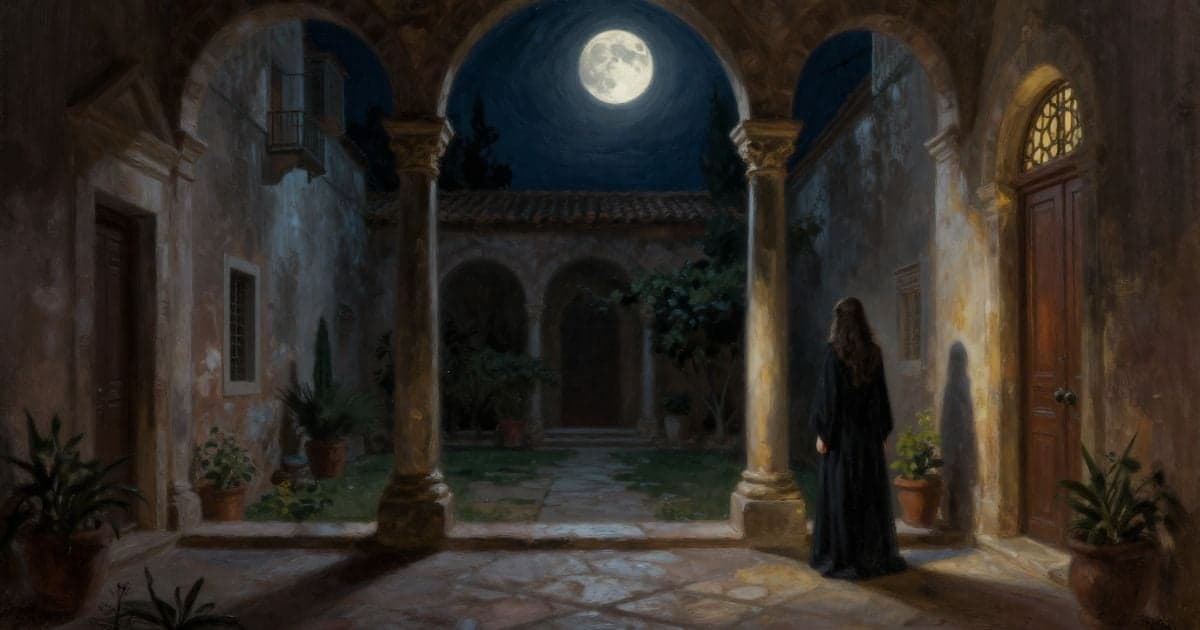
"After much wandering and difficulty they arrived, overcome with weariness, at the gates of a large and gloomy fabric."
Context: The Duke's party finally reaching what they hope is shelter
The 'wandering and difficulty' reflects the Duke's entire quest - he's lost, exhausted, but still pushing forward. The 'gloomy fabric' suggests this isn't the salvation he hoped for. Physical weariness mirrors his spiritual and emotional exhaustion, but he can't stop.
In Today's Words:
After getting completely lost and worn out, they finally made it to this big, depressing building.
Thematic Threads
Obsession
In This Chapter
The Duke's relentless pursuit blinds him to reality and leads to violent confrontation with innocent people
Development
Escalated from earlier romantic fixation to dangerous delusion with real victims
In Your Life:
You might recognize this in your own inability to let go of a relationship, job, or goal that's clearly not working.
Social Hypocrisy
In This Chapter
The monks appear pious but are drunk and feasting, showing the gap between public image and private reality
Development
Continues the book's pattern of exposing false appearances across all social classes
In Your Life:
You see this in workplaces where management preaches values they don't practice, or in your own tendency to present a perfect image while struggling privately.
Class Assumptions
In This Chapter
The Duke assumes his noble status gives him the right to pursue and capture others regardless of their wishes
Development
Shows how aristocratic entitlement justifies increasingly violent behavior
In Your Life:
You might catch yourself assuming your position, experience, or education gives you the right to override others' boundaries.
Physical Consequences
In This Chapter
The Duke's fever and illness finally force his body to reflect the chaos his obsession has created in his mind
Development
First time the book shows mental turmoil manifesting as physical breakdown
In Your Life:
You've probably experienced how stress, denial, or obsessive behavior eventually shows up in headaches, insomnia, or illness.
Mistaken Identity
In This Chapter
The Duke's targets turn out to be completely different people fleeing their own oppressive situation
Development
Introduced here as a major plot revelation that undermines everything the Duke believed
In Your Life:
You might recognize this in assumptions you've made about people's motivations, relationships, or situations that turned out to be completely wrong.
You now have the context. Time to form your own thoughts.
Discussion Questions
- 1
What convinced the Duke he had found Julia, and what was the reality of the situation?
analysis • surface - 2
Why did the Duke become so certain he was tracking the right people, despite having limited evidence?
analysis • medium - 3
Where do you see people today becoming absolutely certain about something they desperately want to be true?
application • medium - 4
How would you design a system to check yourself when you're feeling too certain about something important?
application • deep - 5
What does the Duke's physical illness at the end reveal about the connection between our mental state and our body's response to reality?
reflection • deep
Critical Thinking Exercise
Test Your Certainty
Think of something you feel absolutely certain about right now—a relationship, a work situation, a family member's behavior, or a personal goal. Write down three pieces of evidence that support your certainty. Then force yourself to find three pieces of evidence that might contradict it or suggest you could be wrong. Notice how your brain resists this second task.
Consider:
- •Pay attention to how uncomfortable it feels to look for contradicting evidence
- •Notice if you find yourself explaining away evidence that doesn't fit your certainty
- •Consider whether your emotional investment in being right might be affecting what you see
Journaling Prompt
Write about a time when you were absolutely certain about something that turned out to be wrong. What signs did you miss? What would you do differently now?
Coming Up Next...
Chapter 6: Voices from the Depths
As the Duke recovers from his wounds and fever, new developments unfold back at the castle that will change everything. Meanwhile, Julia's true fate begins to reveal itself in ways no one expected.