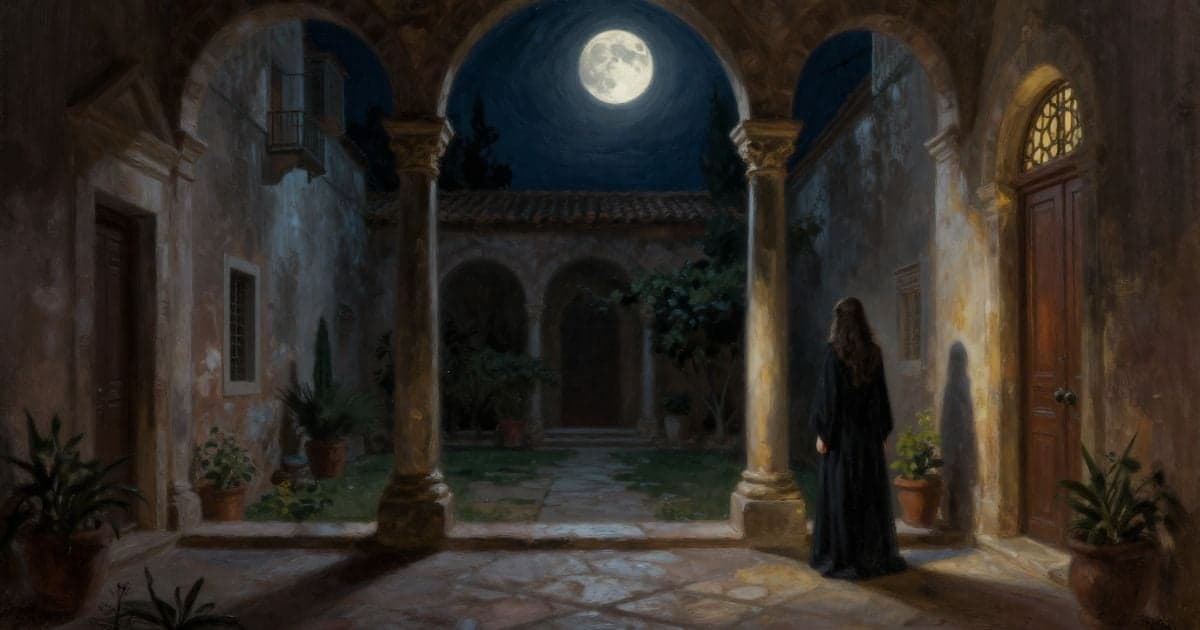
Ferdinand's coming-of-age celebration finally brings music, company, and Count Hippolitus de Vereza into Julia's guarded life. She dances with him, hears grace and seriousness in a man unlike the flatterers around her stepmother, and believes she has found reciprocal love when he leaves a sonnet beneath her window at midnight. For a brief interval the castle feels like possibility rather than prison; even Emilia shares the brightness while Madame de Menon watches with affectionate caution. Hippolitus departs abruptly for Naples to attend the dying Marquis de Lomelli, leaving no farewell; Julia marks his absence in restless expectation at table and in music, and the chapter's first movement turns from enchantment to uncertainty.
When Hippolitus returns, the marchioness, who desires him herself, treats Julia as a rival rather than a stepdaughter. Her jealousy surfaces at the seashore when she interrupts Hippolitus kneeling in declaration to Julia, then withdraws with ironic cruelty that poisons the household air. Julia spends the intervening days under that watchful gaze, unable to speak with Hippolitus except in brief, guarded moments while the marchioness treats every courtesy as provocation. Ferdinand later assures the count in a private room that Julia loves him, recounting her grief during his absence and her brightened spirits at his return. Julia overhears from the half-closed closet door, is discovered by Hippolitus, and flees mortified yet certain of mutual affection.
The family shifts apartments, and Julia finds a miniature portrait of her mother hidden in a cabinet. Madame de Menon tells the full tragedy of Louisa Bernini, whose first love was destroyed by volcanic ruin, a duel, and a forced marriage to the marquis that broke her health and spirit. The story gives Julia a dead mother who was loved and wronged, not merely absent, and explains why the southern wing's mystery feels like family inheritance rather than random horror.
That night the abandoned buildings sound again: sighs, footsteps, and movement where the marquis insists there is nothing. Ferdinand, now curious where others are frightened, searches Julia's chamber and discovers tapestry covering a wall that does not sound solid. He has found the architectural edge of the secret Vincent died trying to name. The marchioness watches both siblings with jealous attention, and the household's glitter cannot hide that pleasure and punishment are administered by the same hand.
The festival's romance therefore collapses into two parallel discoveries. Julia learns what maternal loss cost her family, and her brother finds physical proof that the castle's official map is a lie. Guests depart, music fades, and the household returns to the acoustic dread that preceded celebration. Julia ends the chapter holding a secret door and a secret love, both dangerous to name. Love opens the chapter; jealousy, history, and hidden doors close it.